Feeds:
Posts
Comments

Archive for the ‘Wild’ Category

IMG_0107

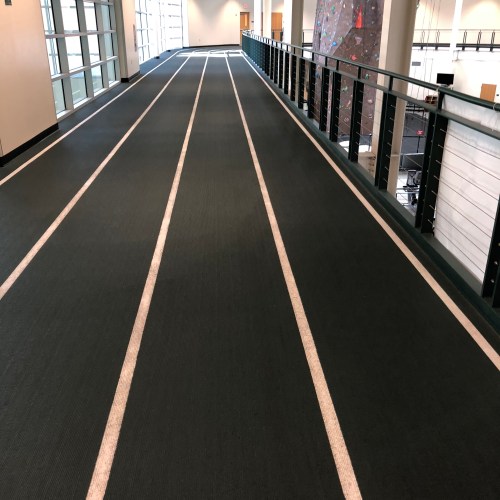
UNT’s running track at the rec center – sometimes brave is sweating in front of people 20 years your junior.
(photo courtesy of my coworker Debra)

Week 2 Progress:

Miles completed this week: 2.14 (out of 10 that I planned)
Total miles completed: 8.19 (6.81 behind schedule)
Days of proper hydration: 3/7
Days of good food choices: 4/7

Hmm.

I did not have a productive week as far as my mileage goal is concerned. I’m not sure why, but I have a few guesses.

It could be that I was on vacation, so my schedule was off-kilter (6/10 probability – this was the biggest difference between last week and this week).

It could be that I was writing about safety and, conversely, all the ways that running can put me in a not-safe situation, and that was enough to push what little desire I generally have to exercise off the ledge (3/10 probability – no remarkable spike in anxiety levels, which I would expect to accompany this reason).

It could be that I didn’t have time (1/10 – lol no – I stayed busy, but I had plenty of time to get 10 miles in if I’d made the effort).

The good news is that my water intake and healthy (and also delicious) food choices improved. I cooked more than usual, so eating well was easy.

Every time I take a holiday from work, I am more convinced that I will be excellent at being retired. I eat better, I rest better – I do everything better. I actually have time to take care of my life.

What I learned, therefore, from this week off is that I might need to reexamine my priorities and drop some things that keep me from doing better at the basic things that sustain my health (and thus life). I haven’t gone much farther in the thought process than just musing, “Hey, maybe I’m too busy,” but I guess that’s a start.


I’m spending 31 days running wild.


Read Full Post »

Not Friday Five

So it’s not Friday…but I’m almost caught up!

We have talked a lot about actions you can take to make yourself safer when you run, but here are five types of classes you can take or exercises you can do to stretch, strengthen, and protect yourself.

  • Pilates is helpful because it works your core. Every exercise, whether it is designed to stretch or strengthen (or both), relies on isometric core work. My favorite is still Winsor pilates. The 20-minute workout doesn’t take a lot of time, but try it a few times a week, and you’ll start noticing differences in your balance and endurance quickly.
  • Another good way to stretch and strengthen is to incorporate a regular yoga practice into your life. I like yoga because there is something for everyone. It’s also mentally soothing, which is a plus for most of us.
  • My inner ballerina loooves barre. In fact, the first Pure Barre class I took reminded me of ballet warm-ups. You know, if warm-ups lasted an hour and kinda made you want to throw up (in the best way possible, of course). Do not be fooled by the fact that most of the class takes place on the floor. This is the best strengthening workout I’ve ever done. Hydrate, though. Also, don’t eat before you go to your first class.
  • Kickboxing is a great way to work on your agility. It’s great for runners because it teaches your body how to use its strength in directed movement. As an added bonus, it lets you practice kicking which might come in handy if someday you need to take out an attacker’s knee. Just sayin’.
  • If you’re going to be out and about on your own (running or otherwise), it’s a good idea to have some basic self-defense moves under your belt. There are a lot of videos online, but I recommend taking classes so that you can practice and get feedback right away. I sort of want to take Krav Maga classes.

Tomorrow we wrap up safety week and start our discussion on rest.


I’m spending 31 days running wild.


Read Full Post »

photo (9)

My back porch is as close as I get to hanging outside by myself in the dark.

In planning this post, I had a confusing monologue running through my head: Running in the dark is okay. It’s completely your choice if you prefer it. But do not run in the dark. People are awful and you could die. I mean, you’re a grown person who makes your own choices, and it’s much cooler and less crowded, so run in the dark if you must. But also…don’t. It’s harder to see you and also there are fewer people to hear you scream when you’re attacked. It’s totally your right to run in the dark – why should you give up your freedom because of other people’s potential choices? Because see previous statement re: the terribleness of humans and, subsequently, their potential choices. So when you run in the dark, maybe just lie to me and tell me that you don’t. If you must run in the dark and also tell me about it because you enjoy seeing me cry, you forfeit all rights to be surprised if you get a lecture.

Clearly, I am conflicted on this issue.

Ideally, you could run anywhere at anytime wearing anything and be safe from the degrading behavior of other people. That is not often the reality of the world, though. So with the same intensity that I support your choice to run alone outside, I also worry that you’re going to do so and that bad things will happen to you when you do.

This series is about running wild, and part of that is about facing fears. Suzanne, you might be saying, isn’t running in the dark part of facing fear and blah blah blah. Yes…asterisk. It absolutely can be, and if that is how you are facing your fear, don’t let me stop you. And if you do run outside in the dark and get attacked, it is not your fault. In any way. At all. Period. Exercising your basic right to be out in the world is not an invitation for trouble. The responsibility for an attack lies 100% in the hands of the person who made the choice to perpetrate the attack.

I am not asking you to shoulder the responsibility of someone else’s decision. I am asking that you ponder the difference between brave and reckless and lean away from the reckless end of the spectrum.

For example, when you run in the dark, wear reflective clothing. It might seem like you are safer if no one can see you, but if drivers can’t see you, they might not stop in time to miss hitting you. And as I mentioned yesterday, take your phone.

And perhaps pepper spray.

Or a taser.

[Check the legality of things in your area before you carry them. It doesn’t help you to become a criminal while fending one off. /psa]

Everything you do to stay aware of your surroundings during the daylight? Multiply by two in the dark. This is a time to be at your most heightened attention.

Hypothetically speaking (because remember – we’re not telling me if you actually do run alone in the dark), what are some other tips you might have for night runners?


I’m spending 31 days running wild. 


Read Full Post »

photo 2 (1)

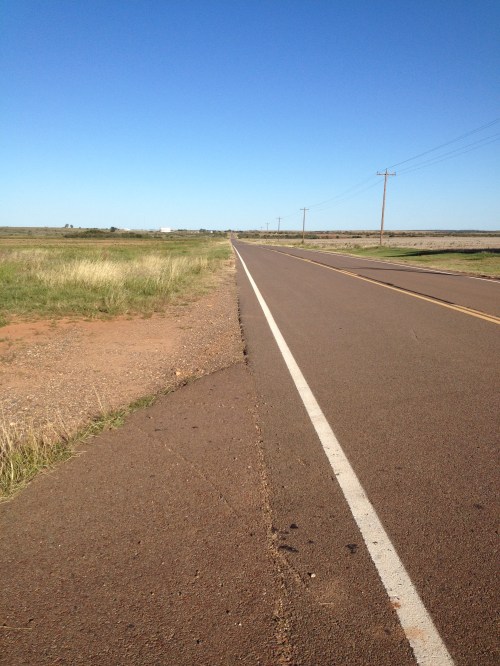
Road and sky

I love this view.

I love a long road stretched out before me so far that I can actually see its two sides meet on the horizon. I love the way the wind sweeps through, breaking on nothing.

I love the big, big sky.

I especially love that, with this view, I can see trouble coming from far off.

You may have a path designated for pedestrians that you run, but if you run on the road, there are a few safety precautions that help keep you safe.

First, take your phone. Just because you can see trouble doesn’t mean you can stop it, and you might need to call for backup. This, of course, is perhaps not as big a deal within the city limits where there are witnesses aplenty, but while strangers can be helpful, it’s not always wise to assume you can depend on it.

If you are running a path that is new to you, and you are going it alone, it’s a good idea to let someone know where you’re going to be. I’m not saying it has to be your overprotective friends that will call 911 if you are a minute later texting them that you’re home safe than they expected you to be. But maybe let the park ranger know if you’re hiking their most challenging trail by yourself.

Second, stay aware of traffic. A good way to do this is to run facing traffic. That is, on a two-way street, run on the left side. When you are facing the cars, you can not only hear them but you can see them without having to twist around.

Speaking of hearing your surroundings, it’s also a good idea to run without headphones. I know that sounds weird coming from a music lover, not to mention from someone who generally would not be described as outdoorsy, but hear me out. If I’m going to be outside, I’m going to make an effort to engage with the outdoors with all my senses. Otherwise, what’s the point? If I’m going to purposely distract myself from my surroundings, I might as well run on a treadmill in the relatively safe, temperature-controlled, bugless environment of the gym. In addition to keeping you in the moment, running with your full aural faculties also allows you to be more aware of your surroundings. You can hear what’s going on around you and give yourself more response time.

What are some other running rules of the road that you use?


I’m spending 31 days running wild.


Read Full Post »

Day 10 – Good Form

photo 1 (2)

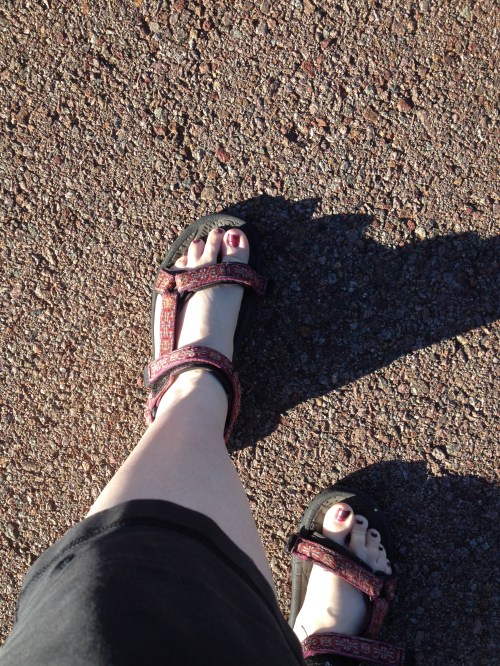
Posed during amphibious walk (thus the shoe choice. Do not run in these. /psa). When actually walking, view from the top should look more like right foot than left. Watch your knees!

Once you have the right gear, you are ready to hit the road safely. Sort of. First, let’s talk about form. How you run is just as important as how much and how often you run. When it comes to running safely, there are four main things to look out for – your alignment, your cadence, your foot strike, and your breathing.

Almost every aspect of good running form begins and ends with alignment. Alignment basically means that every body part stacks and lands where it’s supposed to during an activity. For those of you who are dancers, you know how vital proper alignment is not only to execute a move correctly but also to do so without hurting yourself. Running is no different. As in dancing, it starts with your core. Keep your stomach muscles engaged to protect your back and guide your hips. When your foot strikes the ground, everything should line up. The hips should be over the knee, and the knee should be over your foot.

Your arms can also help you with this. Arms should stay at a 90-degree angle by your side, and hands should be loose. Keep swinging arms by your side, and avoid crossing your arms in front (i.e., don’t cross the zipper line), because this can knock the rest of your body off course.

When runners decide they want to get faster, many will lengthen their stride. This is a mistake. Unless you have extraordinarily developed hip flexors (and let’s presume that, unless you are a pretty serious dancer or runner, you don’t), you are setting yourself up for injury. A safer and more effective way to increase your speed is simply by speeding up your cadence (total number of foot strikes per minute).

Some experts will say that it doesn’t matter how your foot hits the ground, but a heel strike inevitably slows down your cadence, because since you don’t push off with your heel, your foot then has to roll to a push-off position. If you strike and push in the same position, you can increase speed more easily.

Heel strikes also increase the chance of injury, especially for beginners or those with knee issues. Until running with proper alignment is second nature to you, you should avoid a heel strike. When you land on your heel, your hips tend to hang back to prevent you from falling, which means that your hips, knees, and foot aren’t aligned when your foot strikes the ground. I can personally attest that a heel strike makes it super easy to hyper-extend your knee.

Practice running barefoot through grass to get used to a natural heel strike. You’ll probably notice that in this natural state, your body doesn’t land on the heel or, if it happens to, it doesn’t feel good. That’s not an accident. Listen to your body. It knows what works best for it.

Finally, remember to breathe. Of course, breathing is important to keep your body fueled with the oxygen it needs. But how you breathe is important, too. Many experts, including my junior high running coach, suggest inhaling for three steps and exhaling for two. This pattern is not arbitrary. Remember those core muscles that keep your body aligned? When you exhale, your diaphragm relaxes, and so do the core muscles surrounding it. When this happens, other muscle groups in action will compensate for the lost support. By inhaling for an odd number of steps and exhaling for an even number, you alternate the side of your body that’s compensating for that initial exhalation release. This spreads the work evenly and helps prevent injury that might occur if one side gets overworked.

In the next post, we will talk about what to do when you’re out on the road to keep yourself safe.


I’m spending 31 days running wild. 


Read Full Post »
Day 9 – Gear Up

photo (8)

FAVORITES

We are starting off our discussion of safety by talking about what to wear and how to run. Safety begins before you ever take a step.

First, you need the right gear.

I recommend going to a place like Luke’s Locker, at least to buy your first pair of running shoes. Everyone’s foot and foot strike are different, so it’s important to find the right shoe for your particular needs. Most people, left to their own devices, will buy the wrong size shoe because they fail to take into account issues like sweat and swelling, both of which tend to occur when running. Find a store where the sales associates will measure your foot. I like Luke’s Locker because they also have you walk and run and watch your foot strike. I was skeptical at first, but then they matched me with my favorite running shoes I have ever worn, so now I’m a firm believer. I was astounded at the difference this service made.

Fair warning, though – if you take your shoes off without untying them first, the sales associate will yell at you. It compromises the integrity of the shoe’s structure (and thus its ability to protect you). I mean, they’ll yell nicely, because customer service, but still. They’re pretty passionate about it, which I can appreciate.

In related news, if such a store also sells other running gear (e.g., bras), have them measure you for that as well. You won’t be sorry. Best bra ever. It’s also a good idea to buy shorts, leggings, shirts, etc., that wick moisture away from you. Chafing is unpleasant no matter where it occurs.

Once you are properly outfitted, start thinking about your form. We will discuss form in the next post.


I’m spending 31 days running wild.


Read Full Post »

Day 8 – Safety Week

Note: I am at my parents’ farm for the first part of the week, and I am experiencing technical difficulties. For example, the fun thing we seem to be doing tonight is only allowing one browser to be open at a time (yes, I’ve checked all the things. It’s not any of them. It’s just the Internet hates the country). As you can imagine, I’m taking this in stride with the utmost patience and grace (/sarcasm). Posts are being written, but they might take a minute to get to the Internet. Ditto for pictures.

But safety is a crucial topic, so we press on.

The first couple of days of safety week will be about physical safety. These are important issues for everyone, but especially those of us who aren’t as nimble as we used to be.  We will spend some time talking about gear and preparation but also about awareness when you are out running, particularly if you are running in a new, unfamiliar area.

The two days after that will be about personal safety. Of course, this is also physical but it has less to do with safely performing the act of running and more to do with being as safe as it is in your control to be. We’ll talk about things to look out for and things you might think of avoiding (or at least think of never, ever telling me if you refuse to avoid them).

We will end the week with five exercises that go well with running and can help you strengthen so that you can run more safely.

Hope you enjoy!


I’m spending 31 days running wild.

Read Full Post »

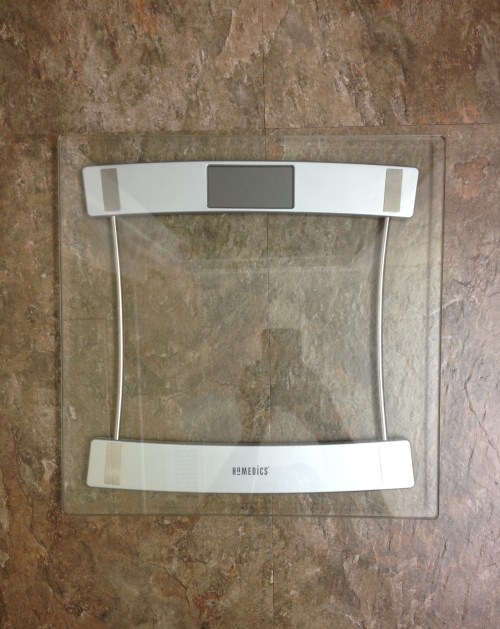
photo-7.jpg

Still Life with Scale

Progress for Week 1:

Miles completed: 6.14
Days of proper hydration: 1/7
Days of good food choices: 0/7

If you just look at the numbers above, you might think I had a bad week. But progress and perfection are not the same word.

Those numbers don’t tell you that, even though I’m not an exact 7/31 of the way through my 50-mile goal, I’m actually a little bit ahead of the training schedule for safely increasing my intervals. My goal for the week was five miles, and I reached it Thursday.

Those numbers don’t tell you that, even though I only reached my goal of 100-120 ounces of water once this week, it’s still one day more than I reached it the week before, and I almost made the goal every day. My skin is also remarkably less scaly this week. Water is a frickin’ miracle.

Those numbers don’t tell you that, although I didn’t have one day when I could honestly say I ate well all day, I was more mindful of choices and made a few good ones. A day that I consider a good food day is one in which my food choices leave me satiated but not sluggish or squirrely. This typically looks like lots of fruits and vegetables, limited meat, and a low salt and sugar intake (which automatically controls for the carbs I tend to overindulge in). Even though I ate like crap this week, I maintained my weight from the week before.

You might notice, however, that weight loss is not one of the goals I’m measuring during this project. In fact, I’m going to talk about it once, and then you won’t see or hear about the scale the rest of the month. I keep track of my weight because, as I personally do not have any condition that makes me gain or lose weight regardless of the food and activity choices I make, it’s an easy way to get an overall view of how I’m doing. But it’s not the only way (or even the primary way) I make this assessment. In my adult life, the time period when I weighed the least was also the time I was the least healthy, so I know weight doesn’t always tell the truth. My focus, energy, and anxiety levels are much more accurate when it comes to understanding how well I’m doing both physically and mentally. Noticing improvements in those areas are how I decide that a new habit is working.

Tomorrow (erm, later today), we start our week on safety.


I’m spending 31 days running wild.


Read Full Post »
Day 5 – Hydration

photo (17)

Don’t leave home without it!

The week I’m talking about hydration is the short week. More accurately, it’s two days. There’s not a lot to say about hydration except, “Do it.”

Our bodies need water, and they need more than a lot of us drink. If I don’t think about it, I might drink 20 ounces of water a day. That is abysmal. Sure, I get water from tea and vegetables and fruit, but still. That is not enough.

There are many websites out there that tell you how much water you need. Some of them will tell you to get a certain number of ounces, period. Some of them will offer you a way to input a few factors and then calculate how much you need (keep in mind that the calculation in that link is for the hours that you spend exercising. Otherwise, that is sooo much water and probably not necessary). Most of them include amounts as part of a larger discussion on how to tell you are getting enough water. I like those the best.

We each have different hydration needs depending on various factors: age, weight, activity level, etc. Through trial and error, I have discovered that I operate best on about 100 ounces of water a day. If I am more active some days (or if I’m spending time out in Texas’s signature heat), I will add 10-20 ounces on those days to compensate for the extra water loss through sweat.

If you are starting to add more activity to your life, what I encourage you to do is try out different levels of fluid intake and see how it affects you. Then you can make the choice that is best for you.


I’m spending 31 days running wild.

Read Full Post »
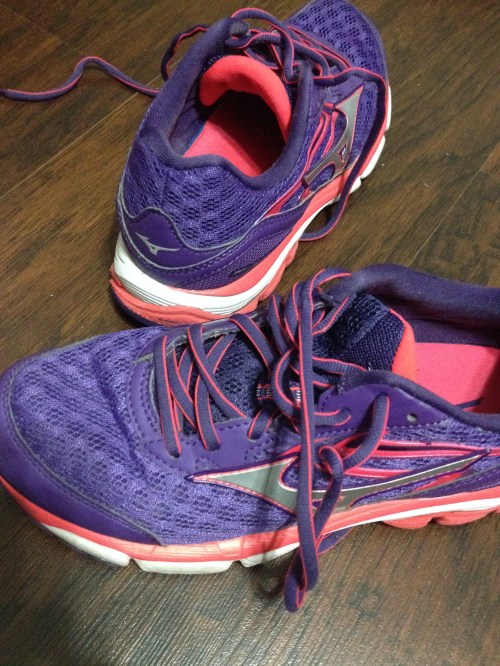
photo 1 (14)

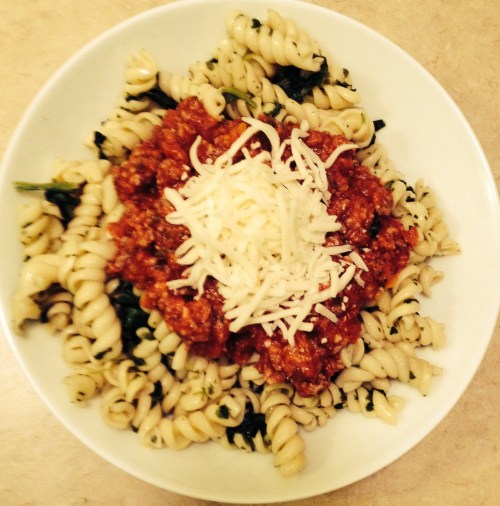
Carb-load, you say? Don’t mind if I do.*

*Warning: eating this much pasta at once might come closer to inspiring you to lie on the couch rather than replenishing you. There’s a difference between fueling and outright gluttony.

One thing I love about having a regular running practice is that I don’t necessarily monitor what I eat, but I end up eating better anyway. I tend to cut out soda, because running (walking…hiking…breathing) on days that I’ve had a Dr. Pepper is so much harder. I had a Cherry Coke today, and I thought that little hill back to the office was going to kill me. I am also not a fan of running when I’ve had a lot of dairy-intense food, regardless of how many pills I’ve taken to corral the lactose. I tend to stop doing things that make me feel extra exhausted or nauseated.

I also more readily notice food that gives me more energy. I eat pasta more often than usual, but instead of the ratio of pasta-to-vegetable pictured above, it reverses. Veggies become the stars of the dish. I tend to eat more fruit, and I tend to eat more eggs.

I have tried to follow several recommended diet plans for runners in the past. These are not bad plans. Most of them tell you to eat real food and stop eating junk, which is good advice for anyone, really. My focus would wane, though, after about the first couple of weeks (i.e., after the first round of groceries disappeared). I also found I had to tweak most plans too much to make them work for me. So I made my own plan. Running is probably what taught me to meal plan effectively.

What are your go-to snacks/meals when you are increasing your activity level?


I’m spending 31 days running wild. 

Read Full Post »
« Newer Posts - Older Posts »