Feeds:
Posts
Comments

On the remaining Saturdays of the month, I want to talk about why keeping house is important to me. As today is World Mental Health Day, I thought it fitting to talk about how keeping house affects my mental health (and, by extension, the rest of my life).

So what does it matter if my home is in order? If I live alone, and I’m the only one it really affects, why let it affect me?

First, it’s bold to assume that I have complete control over what affects me. Sure, I can make choices about what deserves my attention and think positively. But when clutter reaches a certain level, my brain is pretty much going to remain in a state of low-grade fight-or-flight until it’s fixed. Overstimulation is an attack on my senses, and my body responds accordingly. Keeping house protects my nervous system and, by extension, my peace.

Second, I have often said that I don’t understand when people tell me to get out of my comfort zone because that isn’t really something that exists for me. In most cases, that’s true. There are very few places out in the world where I feel at ease. But more often than not, it’s not true of my home anymore. Since I’ve been paying attention to making my home cozy this year, I’m usually comfortable there, and that is the thing I love most about it. It’s a much-needed break from the tension of being out and about.

I want my home to be the place that feels most like a sanctuary to me. Of all the places in the world, my home should be the place that feels the safest. Again, this is not completely within my control. When I have angry neighbors whose fights I can hear clearly through the walls or my ceiling, my empathy is at peak attention, and my guard is up. But to the extent that I have the power to do so, I can keep my home clean and free of danger.

Even beyond matters of safety, I want my home to be an environment where I experience rest, especially as I get older. So many health problems are exacerbated by too little or poor quality sleep. I’m not a great sleeper to begin with, and it’s not getting any easier as I age. I don’t need any distractions or other barriers to a good night’s rest. Part of making my home cozy and soothing to my senses is getting rid of unnecessary stimuli.

And I don’t want all of this to take an hour to kick in. I don’t want to have to unwind or adjust to my surroundings when I get home. I want to feel relaxed as soon as I walk in the door.

And keeping house helps that happen.

I’m writing about keeping house for 31 days.

On Monday, I talked about responsible ways to get rid of things. But my favorite way is not to get rid of it at all, but rather to find a better way to use it. I am a shameless repurposer (is that a word? Well, it is now). 

Here are 5 things that I can almost always find a use for in my home:

  • Any shelf or shelving system. I’ve constantly got books and mementos and baby plant cuttings that need to be given a permanent home, so a shelf has to be thoroughly useless before I will get rid of it. I have a short shelf in my living room that is literally half the shelf it used to be. The top was too damaged to salvage, so I sawed it off, and now it’s three shelves instead of five, and it works just fine that way. If a shelf doesn’t fit in my home, it will probably fit in my office at work, or I know someone else who can use it (ah, one of the many benefits of having bookish friends). 
  • Jars. Whether they’re Mason jars I bought when I was going through my canning phase or random jars that held sauce or some other pantry staple, I tend to accumulate a lot of them. They’re handy to use as vases or twinkle light holders. They help me organize by corralling pens, buttons, nails, or other small objects. They also make great to-go containers that I don’t need (or want) to get back (which also takes something off the to-do list of the person who uses it). 
  • Coffee mugs. Again, there are so, so many. Of course, the best use for coffee mugs is holding coffee, but I don’t really need more than one of those at a time (usually). I use them as pen/pencil holders. They personlize my bookshelves. There’s one on my desk at work that holds little knick knacks that people give me that I don’t want sprawled all over the desk.
  • Heavy objects. These inevitably become door stops or bookends. Several of my shelves are open on the ends, and they are still able to house my books without peril due to a jar of pennies, a decorative box filled with mixed tapes from my childhood, and other assorted heavy objects. My closet door in my bedroom is held open by an old boot with a leftover brick from my patio in it. It may be unconventional, but it does the trick.
  • Random cute items. I am not exactly a minimalist (although I really love Cozy Minimalist Home and all things Myquillyn Smith. Life goals, sort of), but I’m not a maximalist either. As in life, I also need some breathing room in my home. But then there are the random cute things. Cow salt-and-pepper shakers. A miniature plushy of Lucky the Squirrel (UNT’s unofficial mascot). Felt roses that a friend made. So many things make great decorations. I’m ten times more likely to display the art my friends make as I am to put up things that were store bought (although I have been know to repurpose those in my own art projects). If I love something, but I already have a more functional option that I actually use, I can still use it to make my home cozier by working it into my design plan. 

I hope you have a great weekend, friends!

I’m writing about keeping house for 31 days.

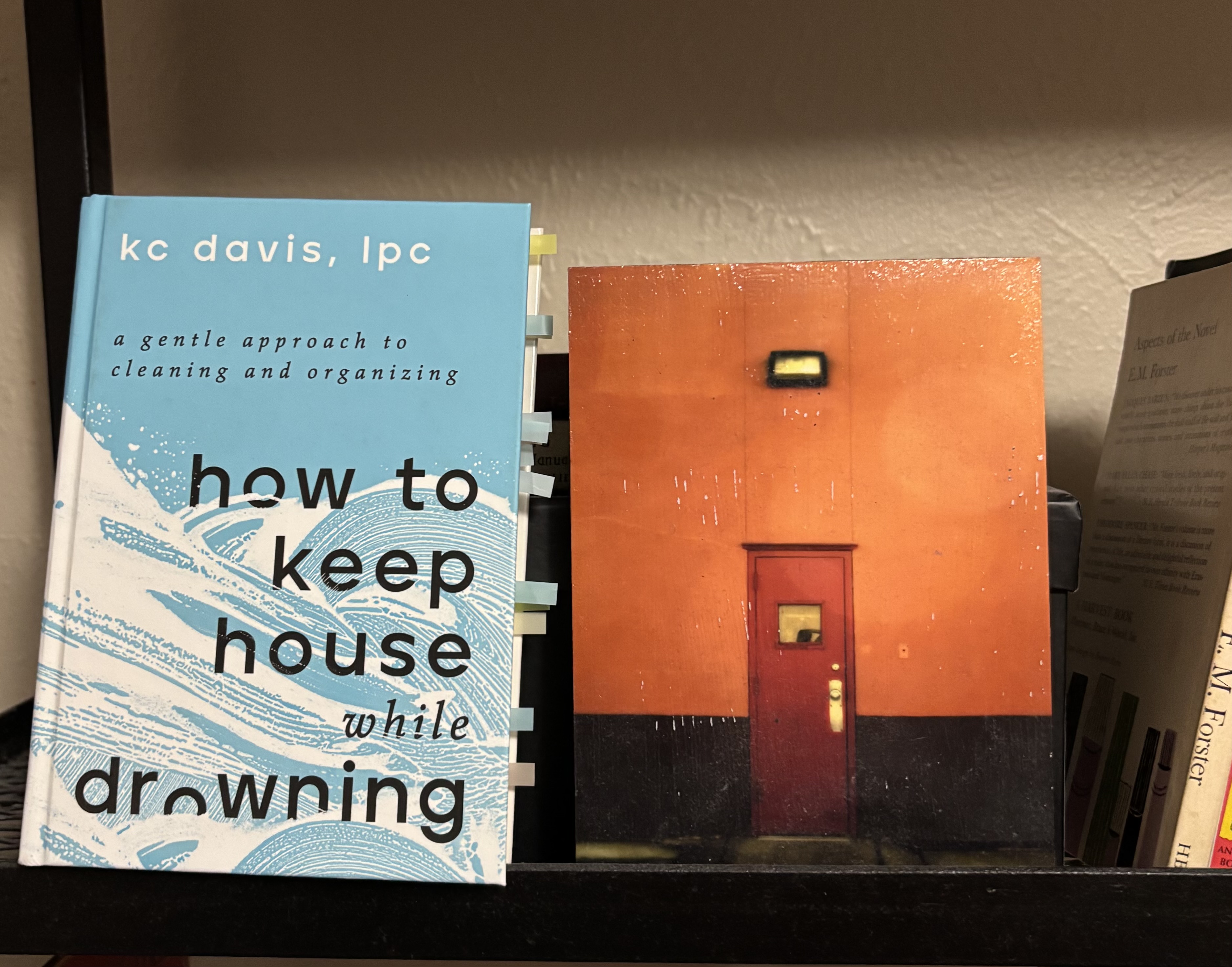
I love How To Keep a House While Drowning. The subtitle is “a gentle approach to cleaning and organizing,” and that’s just what I need. I am not motivated by what I should do or someone else’s standard. Frankly, I’m not even motivated by my own standards. 

I am motivated by grace and understanding and generosity, and this book is an abundance of those things.

In the first few pages, Davis starts in with this wisdom: “You don’t exist to serve your space; your space exists to serve you.” Many of my struggles with keeping house are based on my suspicion that I somehow owe my apartment something. But really? I am there because of my needs (to have shelter) and desires (to be cozy af). Therefore, it makes much more sense to approach it in ways that serve this purpose.

When I approach housework as a way of honoring my needs, my perspective shifts. What would make Future Me happy or help her relax? That is why I clean. That is why I declutter. Not to impress some possible guests but to please myself.

Davis also addresses the binary status of done or not done. The point of housework isn’t to mark something as “done.” Now, initially, this offended me to my very core. You know I love marking things off a checklist. But the point of keeping house isn’t to finish, but to keep it functional. If my expectation is that something is finished, I will get frustrated the next time I have to do it again. But if I change my mindset to functionality, the whole process softens into something more sustainable.

The third thing I love about this book is the statement, “Self-care was never meant to be a replacement for community care.” There’s a whole lovely section on this, but one of my takeaways is the reminder that we still need each other. I can do the best I can with every resource and ounce of energy I have and still not finish all the things. It’s not just OK to help each other; it’s critical.

Anyway, this is easily one of my top five favorite books on keeping house. Highly recommend, especially if shame and unreasonable expectations tend to immobilize you. This book will help.

I’m writing about keeing house for 31 days. You can browse the topic list here!

The smaller the space, the more easily clutter becomes a hindrance. My bathrooms are the smallest rooms in my apartment, other than the closets (are closets rooms?), so keeping them tidy is crucial to their function. 

Conventional wisdom says…many things. Clear your counters. Store items neatly away in cabinets. This keeps your small bathroom looking tidy and neat. It also makes it easier to dust and wipe down surfaces. All these things make perfect sense for a lot of people.

Neurodivergent wisdom says if I can’t see it, then it might as well not even exist. I’m more likely to not only put something away but also be able to find it again if it stays visible. 

Hence the shelves.

There are two categories of items that belong on these shelves:

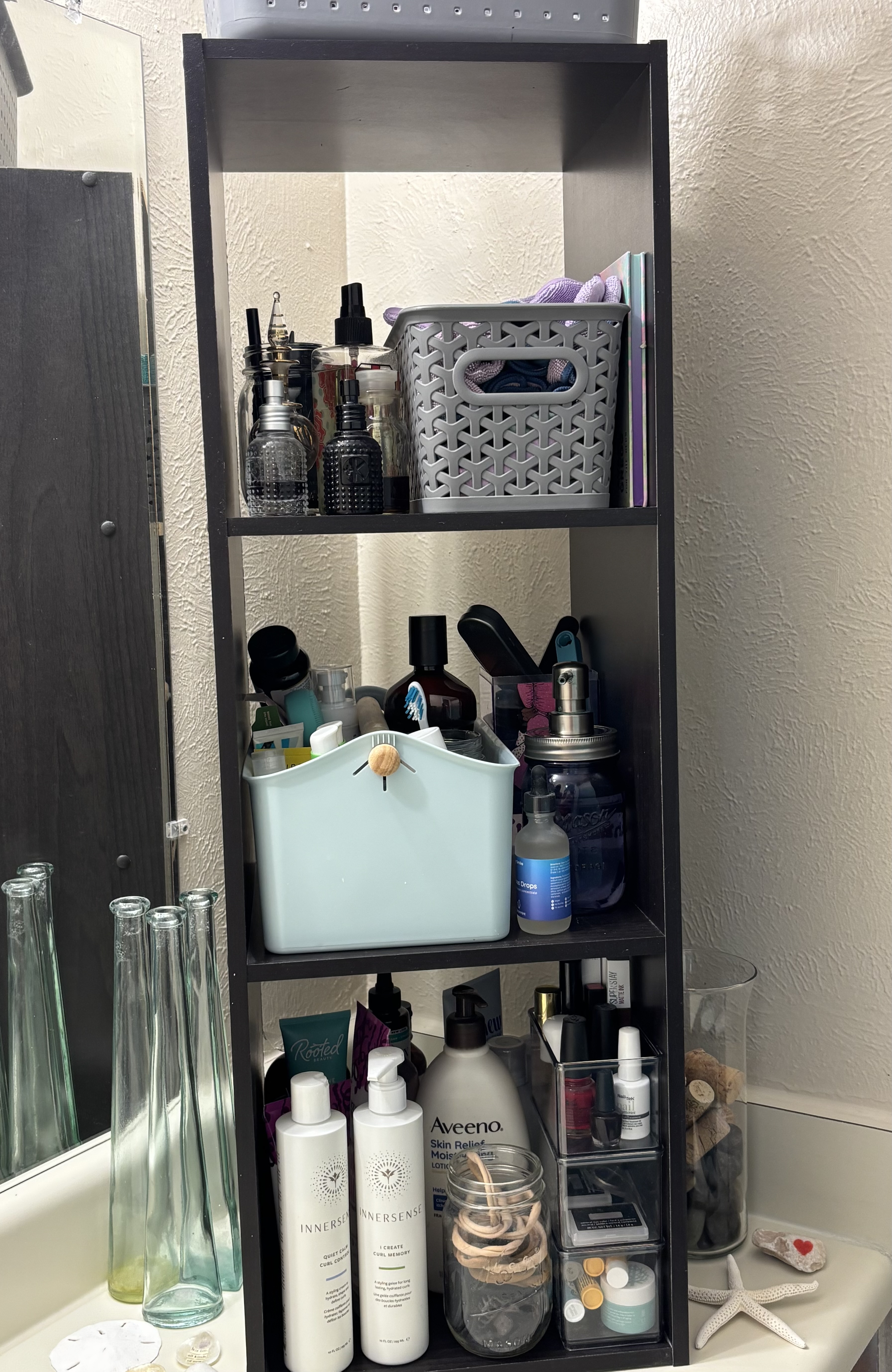
  • Things I use several times a week or every day, such as my toothbrush/toothpaste and hair products
  • Things I use so infrequently that I forget I have them, such as nail polish, eyeliner, or face masks.

It just makes sense to keep the things I use every day out. I mean, I’m going to anyway. There’s no way that I will tolerate taking my hair gel out of the cabinet, using it, putting it down while I scrunch it through my curls, washing my hands, and then also having to remember to put it back in the cabinet. It’s not going to happen. It’s going to end up staying out, so why not just make that the place it belongs? It takes no extra effort to put it down on the shelf than it does to put it down on the counter. Keeping it on the shelf makes it easy to keep it in its place.

As for the things that I use once a month or less, putting them away means inevitably buying ten of the same kind. For example, I used to get weekly manicures. I would pick the same color every time, so I wanted to have a bottle of that color at home in case it got chipped between visits. It didn’t chip very often, so I didn’t need to use what I bought for touch-ups. And I forgot I had it. At one point, I had seven bottles of the same nail color stashed in a drawer. Madness. So now things like that stay out in the open to remind me frequently what I already have.

As you can see in the picture above, there is still an element of design to it. Just because the main purpose of an organizational choice is to maximize function, that doesn’t mean it can’t also look cute. To tamp down some of the visual clutter, I have baskets and buckets for some of the smaller items. I also put mementos from friends and pretty bottles on either side to add a sense of whimsy.

Not shown is the drawer where I keep razors and small extras, such as contact lens supplies. I also keep cleaning products, refills, and washcloths under the sink. So not everything is out in the open. Anything that I use often enough to remember I have it, but not so frequently that it needs to stay easily accessible (the stable middle) can be hidden from sight. I occasionally buy an extra of something in this category, but it’s rare.

My bathroom organization has taught me that the way I keep house doesn’t have to look like everyone else’s. They don’t have to like it. It doesn’t have to work for them. It only has to work for me.

And these shelves really work for me.

I’m writing about keeping house for 31 days. Click here to see the topic list!

Wearing shoes in the house.

Yes? 

No? 

Let’s discuss.

First, taking your shoes off at the door is the norm in many cultures. I (and you) should absolutely respect the rules and customs of anyone who is gracious enough to host us. It’s not that difficult to plan ahead. If I know the homeowner allows shoes in the house, that’s fine. But if I know they don’t, or I don’t know one way or the other, I assume I’m going shoeless once I arrive and adapt my footwear/sock selection accordingly. This is why I own so many cute socks. So thank you, friends with this rule! I do love a cute sock, and this gives me an excuse to buy more of them.

This is not a rule I use in my own home, though. Please feel free to keep your shoes on.

I know. I get it. I understand that shoes are gross and thus track their grossness inside as I am tromping through the house. But also…so do…

  • My clothes
  • My hair
  • My skin
  • My bag(s)

Multiply these elements times how many people live in or visit your home on a regular basis.

Include pets in this count, especially the ones that occasionally go outside (although inside-only animals can do their fair share of spreading some dirt and other particles). This doesn’t necessarily apply to me, as I don’t currently have a pet. And I love my friends’ pets, but they do track in a fair amount of detritus. I used to think I was allergic to dogs, but my reactions change depending on the seasons. So I suspect my sensitivities are more about all the irritants that are hitching a ride on the dogs’ fur after their walk rather than the animals themselves, which is a relief but also solidifies my decision not to adopt an indoor/outdoor pet.

[Aside – No, I do not want an animal in my home. Do not send me pictures of cute, sad animals that need homes. I mean, send me all the animal pictures all the time. I love them. Just do not expect me to adopt them. Your Sarah McLachlan tactics will not work on me. You will be disappointed, and your disappointment will be 100% your own doing.]

Basically, anyone or anything that goes from outside to inside has the outside all over it and thus gets the outside on anything it touches once it comes inside. Therefore, I feel like simply removing my shoes at the door of my home would only address a small fraction of the outdoor-to-indoor filth pipeline.

The main thing from outside that bothers me is pollen. And it’s on everything. During the first few weeks of spring, I absolutely strip down and immediately shower when I get home to reduce how much of the stuff lingers in the air of my apartment. I do enjoy breathing, after all. But this is only a seasonal habit. I only do it when it is absolutely necessary.

I could be a person who does this all the time – a person who deposits outside clothes directly into the washer/hamper, lovingly empties and cleans my purse each night, and not only removes my shoes at the door but wipes them down, removing all the funk they have accumulated in my travels that day. I could, but I’m not gonna. While the idea of consistently having separate outdoor and indoor clothing is appealing to me, it’s not a habit to which I actually aspire at this point in my life. In fact, I think I said, “That’s exhausting. I’m exhausted just reading it,” out loud and then had to stare blankly at the wall for a minute when I came to that chapter in Marie Kondo’s book (which I absolutely loved otherwise – highly recommend).

Also, even if it was just my shoes, what is the process? Logistically speaking, what do I do with the shoes when I take them off at the door? Do I remove them and then pick the filthy things up with my bare hands and take them to the closet? Do I figure out some way to move my whole gigantic shoe storage to my tiny entryway so I can put them where they belong right away? Do I just leave them by the door (real talk – the most likely scenario), thus resulting in the inevitable and constant pile of shoes at the door? None of these things seems like a practical solution that I would want or actually implement, and regarding my primary goal of reducing clutter, they are all inferior to my current process, which is to wait to remove my shoes until I’m in the closet where they belong.

So, for now, in my house…I don’t care, generally speaking. I’m going to keep my shoes on at least as long as it takes for me to walk from the door to where my slippers are, and you should feel free to keep your shoes in my home, too. 

I mean, if your shoes are extra dirty/muddy, take them off or ask for something to wipe them down at the door. Don’t track visible muck through my home. Don’t be that person. 

But overall, I want you, my guest, to feel welcome and accepted just as you are, so you do what makes you most comfortable (re: shoes or no shoes and attire in general, that is – this is not a free-for-all behavioral statement.). Additionally, I believe the way people attire themselves is an art form and expression/extension of their personality, and while it may seem like a small thing, taking off one’s shoes can mess up the whole ensemble. Embracing these principles is part of the hospitality from my southern upbringing (i.e., one element of my culture that I actually like and try to embody) that I want to extend to my guests.

I’m also curious about other people’s take on the subject. Would removing my shoes at the door of my own home really make that big of a difference in how clean it is overall? If flooring is a factor, I have all hard floors, not carpet. So my floors are both easy to clean and are cleaned frequently(ish). 

Feel free to drop your opinion and links to credible research in the comments. 

I’m writing about keeping house for 31 days. Click here to see the topic list!

Reduce, Reuse, Recycle. It’s been the mantra of those who care for the planet and want to minimize the waste they produce for decades. It’s also three helpful hints for keeping house. Nothing gets stuff organized (or gone completely) faster than one of these actions.

Reuse is my favorite of the three. While my main goal for extraneous stuff is to get rid of it, of course, I also really despise having to buy something again to replace that thing I JUST threw away. I am the poster child for “But I might need it someday.” I really do often find uses for the random things I keep. So before getting rid of it, I look for ways to reuse it (stay tuned for Friday for some of my favorite things to repurpose).  

Reduce is my second choice, even though I think it is the best of the three. I wish it were my favorite. After all, the most efficient way not to waste the things that come into your home is to not bring extraneous nonsense into it in the first place. 

I’m just not very good at it. I mean, I have no problem with the things I’m super picky about. For example, I’m not going to impulse buy hand soap. I have the two kinds I like (one for my bathroom, one for the guest bathroom), and while I may stock an extra of each, that’s about it. Yarn, on the other hand…I may have an issue there. 

Reduction also looks different for different households. Take food prep, for instance. Ideally, all my vegetables would be fresh from the farmer’s market where the only packaging I use is the cloth bag I bring from home, and I would prep them for use the minute I brought them inside. But I got exhausted just writing those sentences. If that was the standard I tried to hold myself to, I would be constantly overwhelmed and end up in the drive-through more often than not, which creates the most waste with the single-use cups and utensils and wrappers (oh my). Getting most of my vegetables frozen is a compromise, but it’s better than the next likely alternative.

Recycling is the bane of my existence. I am committed to doing it. I know individuals can’t solve the major environmental crises caused by corporate greed and its inevitable consequences of environmental waste and bad practices and shortcuts (although we can vote with our dollar by not shopping with them whenever possible). And I know that a lot of what goes in the recycling bins (particularly the catch-all ones) ends up as trash anyway. But I adhere to the principle that if everyone did their part by throwing fewer things away, we could maybe at least keep the landfills under better control. I know we definitely can’t keep them under control if we don’t even try. So I’m going to continue doing my part, small as it may be, even though it’s among my least favorite chores. 

[Public service announcement – There are many things that need to be recycled or disposed of responsibly (i.e., not in the dumpster/trash bin), even if doing so is a pain, so please make sure you know the right place to take these items where you live.]

My beef with recycling most things is that it can’t just be done in-house. It involves a task and then also an errand. I hate errands so much. If I ever become inexplicably wealthy, errands are the first thing I’m going to outsource. I would actually hire a person full-time to run my errands for me if I could afford to do so.

If you live in a place where people will come and pick up your donations at your house for you? That’s nice. You should take full advantage of that. If I could just leave a box on the porch and have it magically disappear to a place I trust to use the items responsibly, recycling might become my favorite chore. So step one of recycling is to research the places near you that will do this for you. You may be surprised at how easy they make it.

But most of the local places near me that recycle used items don’t pick up from apartments. Alas. So I gather. And gather. And accumulate. And then…eventually…sometimes with weeping and gnashing of teeth…deliver to the appropriate location.

Maybe if I think of recycling as a quest it will be easier to keep up with. *ponders and plots*

I’m writing about keeping house for 31 days. Click here to see the topic list!

A common characteristic of neurodivergent brains is that we switch attention easily and often. Some call it a short attention span. Some call it easily bored. Some call it multitasking (or if you’re me, rapid-succession unitasking).

Whatever you call this phenomenon, it can make menial tasks a challenge to complete (there is another beast called executive dysfunction that makes things hard to even start, but we’ll save that for another day). Most days, I don’t have a problem getting started on a cleaning project, but my follow-through often gets sidetracked by another task.

One thing I have found helpful in addressing this issue is to gamify decluttering/cleaning. I actually use this with most of the routine things that need to be habits (such as drinking water, remembering to eat, getting exercise, etc.), but it works especially well when it comes to housework, or anything that has clear start and finish points. When I turn decluttering into a game, it gives my attention span the challenge it needs to stay interested long enough to complete the given task.

Here are a few of my favorite games for keeping house.

Finch App

I loooove the Finch app. You have a character (specifically, a birb – mine’s name is Bandit). You can decorate its home and dress it up. You can send it on adventures. You earn the items you need to do all these things by completing goals, which you can customize. For example, some of my goals are:

  • Clean or tidy for ten minutes (x6 per day)
  • Drink 16 oz. of water (x5 per day)
  • Exercise for 3 minutes (x10 per day)

There are several more, and I change them based on the goals I am focusing on at the time.

In addition to getting to send Bandit on adventures and buy her cute clothes, I also use Finch to track my longer-term progress. For example, I track the number of days each month that I complete my 6 units of cleaning. If my history shows I cleaned for 15 or more days in a given month, I give myself a little pat on the back and possibly a small treat. Like, maybe I get a sausage biscuit instead of making breakfast one Saturday. Sometimes, though, just seeing progress is reward enough.

Decluttering Surges 

My brain likes brief bouts of intensity, and this game scratches that itch.  For a set period of time (a day, a week, but not more than a month, or I get bored and distracted), I perform a specific task once per a subset of that time. Sometimes there’s a preset task, sometimes there’s a preset time limit. The constraints are what make the game.

For example, on Saturdays when I am at home all day and have a lot of cleaning to do, I challenge myself to get up and tidy or clean at the end of each hour. For example, when the clock reads 1:50, I put down my book or put aside my writing or press pause on the show I’m watching, and see how much I can get done before the clock turns to 2:00. It’s a race against myself. It not only results in my home being a lot cleaner at the end of the day but also reminds me to get up and move occasionally.

Another example is the challenge I did when I noticed piles were getting out of control. For one month, I tasked myself with getting rid of one bag or box of stuff (or one item, if it was too big to fit in a bag or box) per day. It was simple but effective.

Spot Cleaning 

Sometimes stuff accumulates. Or it looks dusty. Or something is wrong that will just take a few minutes to put right. Sometimes my decluttering surges focus on one small area.

Take the shelf pictured above. It is designated as a space for mementos and knick knacks, but a couple of weeks ago, I noticed that it had also become a dumping ground for items that I was using in the area and just didn’t put away. A hammer and some nails, a hold sticker from the library, a coffee mug, etc.

So I set a 5-minute timer on my phone and got to work:

  • I removed everything from the shelf.
  • I dusted the shelf and each item that belongs there as I put them back.
  • I took the other items and put them up where they belong.
  • With the time I had left, I also dusted the shelf above it that holds the TV and moved the Christmas mouse figurine that was lingering next to it to my Christmas storage box (better late than never, I guess).

So in five minutes, I accomplished twice as much as I intended to. I won!

Spot cleaning is especially useful for those areas of my home that overwhelm me. I spot-clean my office a lot. It’s a small space that, unlike the rest of the apartment, I don’t use every day. It’s easy for it to become a dumping ground, and it doesn’t take long for it to look like it belongs on an episode of Hoarders. Such a sight makes me want to shut the door and run away. But I just got released to work from home three days a week, so it has to be functional. In the past month, I’ve made it my mission to spot-clean at least one shelf, one surface, or one square foot of floor per day, and the difference that has made in just a few short weeks is astounding.

It may seem silly to have to turn common chores into games just to get them done. But all I hear from that sentence is that they’re getting done, and any method that makes that happen consistently will always be welcome in my home.

I’m writing about keeping house for 31 days. Click here to see the topic list!

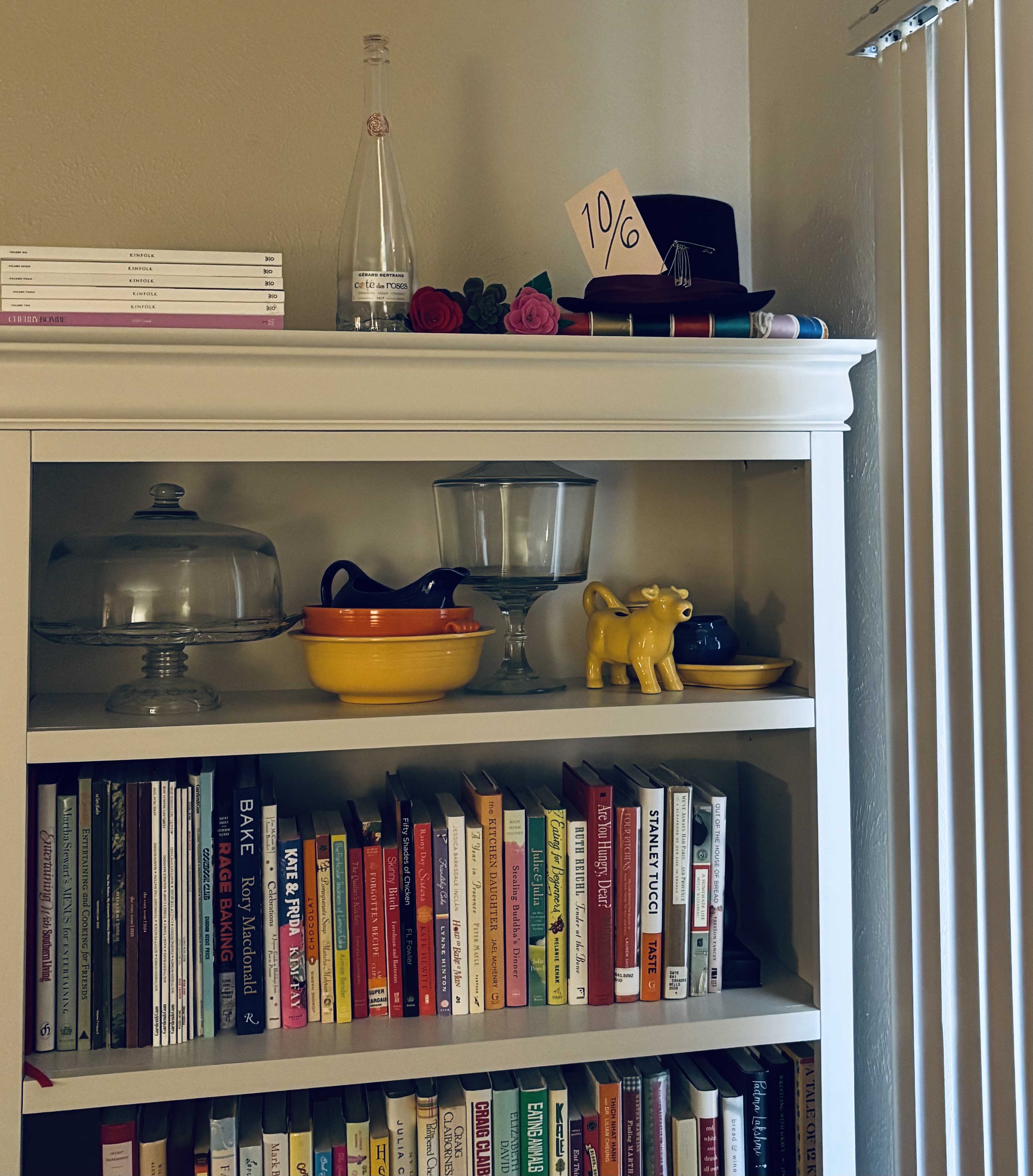
At any given moment, my book collection is either the most organized part of my home or the most out of control. There are just so, so many of them. I love being surrounded by books, but if I’m not careful, I’m tripping over them just as often as I’m reading them.

All my bookshelves have a specific purpose. For example, most of my nonfiction belongs on the large metal bookshelf in the office. Library books and other borrowed books share a shelf with music collection in my bedroom so that they don’t get mixed in with the books I own. Fiction, memoir, cookbooks, short stories, and poetry – all my beloved genres have a specific place they belong.

The challenge is getting the books to where they belong, especially when they’re new. While I’m really going for a home library that is full of anticipated books, some of which I recognize I may never read, the decision to keep a book is not automatic. I have monthly subscriptions at a couple of independent bookstores (specifically, Deep Vellum in Dallas and Fantastic Strangelings through Nowhere in San Antonio), and I frequent library book sales and yard sales where I 100% judge books by their covers, so it’s anyone’s guess as to what I will actually bring home. I always seem to be obtaining books, and not all of them are ultimately meant to remain in my personal collection.

Of course, this means that they’re already in my home before I vet them and decide they need a permanent place there. The shelf by my reading chair in the living room is devoted to this purpose. It houses new-to-me books that I’m not sure I’m keeping yet. It also keeps the books that I’m planning to read next stacked in a neat little pile for my convenience.

This month’s TBR is loosely inspired by that shelf.

Aside from my book club reads, many of the books listed below are hanging out on this shelf – in limbo, awaiting a decision on their final destination. Hopefully, my reading this month can make a dent in deciding which ones to keep and which ones to pass on to someone else.

[Disclaimer – I am a Bookshop.org affiliate – I get a cut of the sales from most of the links below.]

Book Clubs

Cozy(ish) October Vibes

Cozy horror is an odd category. I’m drawn to it. In fact, it may be quickly becoming one of my favorite genres. 

Most genre-ists define it with elements of gentle supernatural components, low stakes, lovable/misunderstood monsters/creatures, and maybe a quirky, small-town environment with a smattering of snarky talking animals. It is likely to heavily feature a coffee shop, bakery, or niche store that caters to a granny hobby.

I do love books that fall into that definition of cozy horror, and my definition certainly includes them, but it is also broader than that.

I define the genre as horror…but make it funny. Many of the descriptions of the books I place in this category contain phrases like “darkly humorous” or “charmingly gruesome.” The ending may not be happy in the traditional, sunshine-y sense, but it will probably be satisfying, and that’s just as good.

October’s an especially great month for cozy horror. Or dragons. Or both.

Reading Challenges

I’m not actively working toward my reading challenges that I have left, I’m finding at least one prompt that fits almost every book I finish. So I have another one that lacks one more prompt and a few more that I anticipate chipping away at this month.

  • Kingdom of Ash by Sarah J. Maas – Not only to finish this series and put it behind me but also to finish up the Overeducated Women With Cats challenge with the prompt “set in a fully invented world.”
  • “A book about books” is the October prompt for Read Your Bookshelf. I have so many; it shouldn’t be hard to find one. Possibly even on that shelf of to-be-curated books.
  • The Hacienda by Isabel Cañas – Originally planned for January/February, this satisfies the prompts “a diacritical mark on the cover” and “gothic fiction written in the last 10 years.” Gothic fiction often intersects with cozy horror, so it’s at least theme adjacent.

Where do your books live in your home?

I’m writing about keeping house for 31 days. Click here to see the topic list!

Day 2 of Keeping House is a list of small things that can make my house look like I cleaned a lot.

The main reason that cleaning and tidying get away from me at home is time. There never seems to be enough of it for everything I want to do. On busy days, I just want to come home and stare at the wall. I don’t have the bandwidth for anything else once I’m finally finished for the day. But even at the end of less busy days, I want to spend the energy I have left doing creative things or reading or maybe seeing a friend I haven’t seen in a while.

Housework is often at the bottom of the priority list. After all, I’m usually the only person it affects, and most days, I just don’t care about it nearly as much as my raising would indicate I should. It’s the easiest thing on the to-do list to brush off. After just a little while, though, that brushing off really adds up, and I suddenly and desperately want a quick fix that significantly improves the overall state of my home.

Enter the microtask.

These are things I can do with a short amount of time (10 minutes or less) without using every single scrap of my leftover energy that still make a noticeable difference:

  • Laundry – start a load, move it to the dryer, or even put it away. Any of these smaller tasks can be accomplished in less than 5 minutes (well, maybe a little more on the third step if there’s a lot to be folded, but it’s still relatively quick).
  • Clear off a flat surface. Even big surfaces don’t ever take as long to clear as I think they will. For example, my dining table gets cluttered fast, and I put off clearing it because I think it will take too long (and thus psych myself out). When I actually clear it, though, I’m always surprised by how quickly I can do it.
  • Do a cup sweep. Are there coffee/tea cups lingering throughout the apartment? (Answer: Yes. Perpetually) Move them to the kitchen.
  • Speaking of the kitchen, wash all the dishes in the sink and put them away. What if there aren’t any dishes in the sink, you ask? Then it is truly a miracle day, and the microtask becomes a hearty pat on the back for a job already well done. Thanks, Past Suzanne!
  • Take out the recycling or trash. Somehow, there is always at least one box or bag that needs to go out, or several small bits that I can consolidate into one. 

Completing these microtasks isn’t going to fool anyone into thinking I have my domestic life together. But it does serve two important purposes – they get something done, and they remind me of how easy it is to get something done. 

And that, too, can really add up.

I’m writing about keeping house for the next 31 days. Click here to see the list.

31 Days of Keeping House

When I chose cozy for my theme this year, my home was one of the main focal points of that goal. What I quickly discovered is that the cozy elements were already there – the comfy linens, the coffee and tea nook, the fairy lights, a little reading nest in every major room, etc. Unfortunately, they were often hidden behind clutter or overshadowed by household chores waiting to be done.

Before I could have a home that I (or the occasional someone else) could experience as cozy, the issues blocking all my carefully curated comfort zones had to be addressed. I’ve spent a lot of time doing that this year.

This month, I’m talking about keeping house. Not the pristine clean of my childhood, where you could eat off the kitchen floor with no adverse consequences (other than my mother yelling at you not to mess up her clean floor). But a reasonable level of clean. What most people would consider clean. The tidy kind of clean that instantly calms me when I walk through the door.

To be clear, I am not naturally good at this. I’m prone to stacks and piles and items left wherever they landed when I got distracted by another task. I have books and journals not only piled precariously high on the table by my reading chair but also stacked on the arms of the chair itself. I often have dirty coffee and tea mugs scattered everywhere. I have a chair in my bedroom that I usually cannot sit in because it’s full of discarded clothing. I organize files for an hour only to realize that, instead of organizing, what I have actually done is create 4,321 more piles of paper.

Even so, I deserve to have a home that feels cozy and peaceful. Even if keeping house doesn’t come naturally to me, I can still maintain such a home with a few handy tricks and routines.

This is not a do-this-for-a-month series. This is a talk-about-and-plan-it-for-a-month series. This is too daunting a project for me or anyone who identifies with my struggles to be successful in just 31 days. Also, we can’t just do it for a month and call it quits. Unfortunately, no kind of cleaning, tidying, or decluttering is a one-and-done deal. It’s a lifestyle. Apparently. This is an offensive fact about adulthood and physics, and I stay mad about it.

I am writing this series because focusing on cozy this year has worked. I have become a little better at cleaning and tidying this year, and I want to celebrate that a little bit. 

I also want to share the things I’ve learned in case it does not come naturally for you either. There are the things I’ve done throughout the year to reduce the overall clutter in my home and make it a cozier place to live. For the things that seem to have become routines, I will include how often I have to do them to maintain what I originally accomplished. 

While I myself am far from being an expert, there are those whose wisdom on the subject I consume voraciously, and I have several favorites. I find their books, websites, and other resources delightful. It turns out, I absolutely love reading about cleaning and tidying. People who really nerd out about it both fascinate and charm me. I will drop links in posts where their signature advice is mentioned.

Taking care of a home is often seen as fundamental to being a functioning adult. On this particular critierion…I’m alright (most days). I suspect that a lot of people can relate to that. That’s my main target audience for this series. Let’s learn together! 

I also would love for people who are good at keeping a clean, decluttered home pretty consistently to read and chime in. Teach us your ways!

You can subscribe to follow along day by day, or just come back occasionally to this post, which I will update as a table of contents as each day goes live. As with any general, prescriptive advice – take what you need and leave the rest.

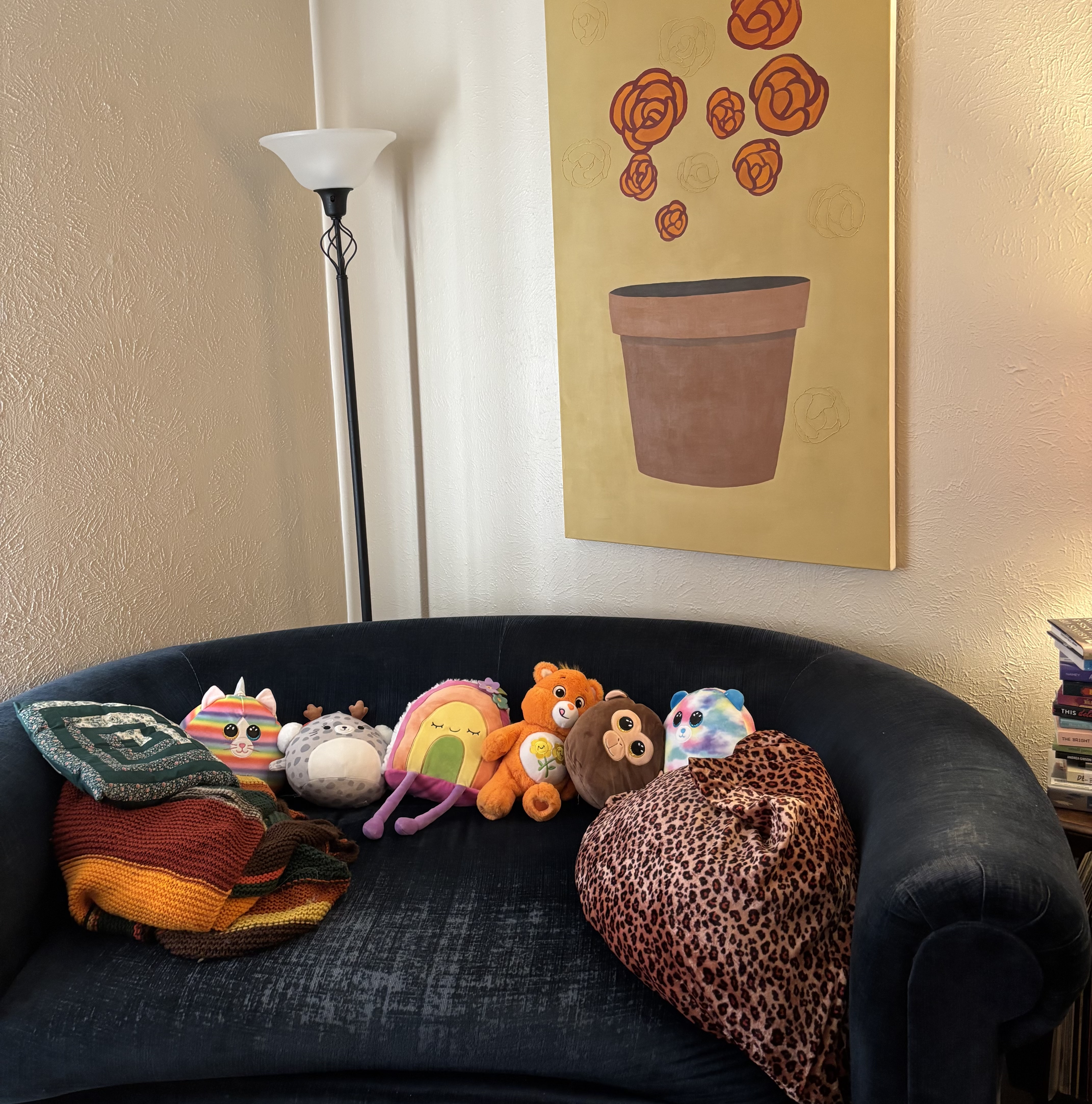
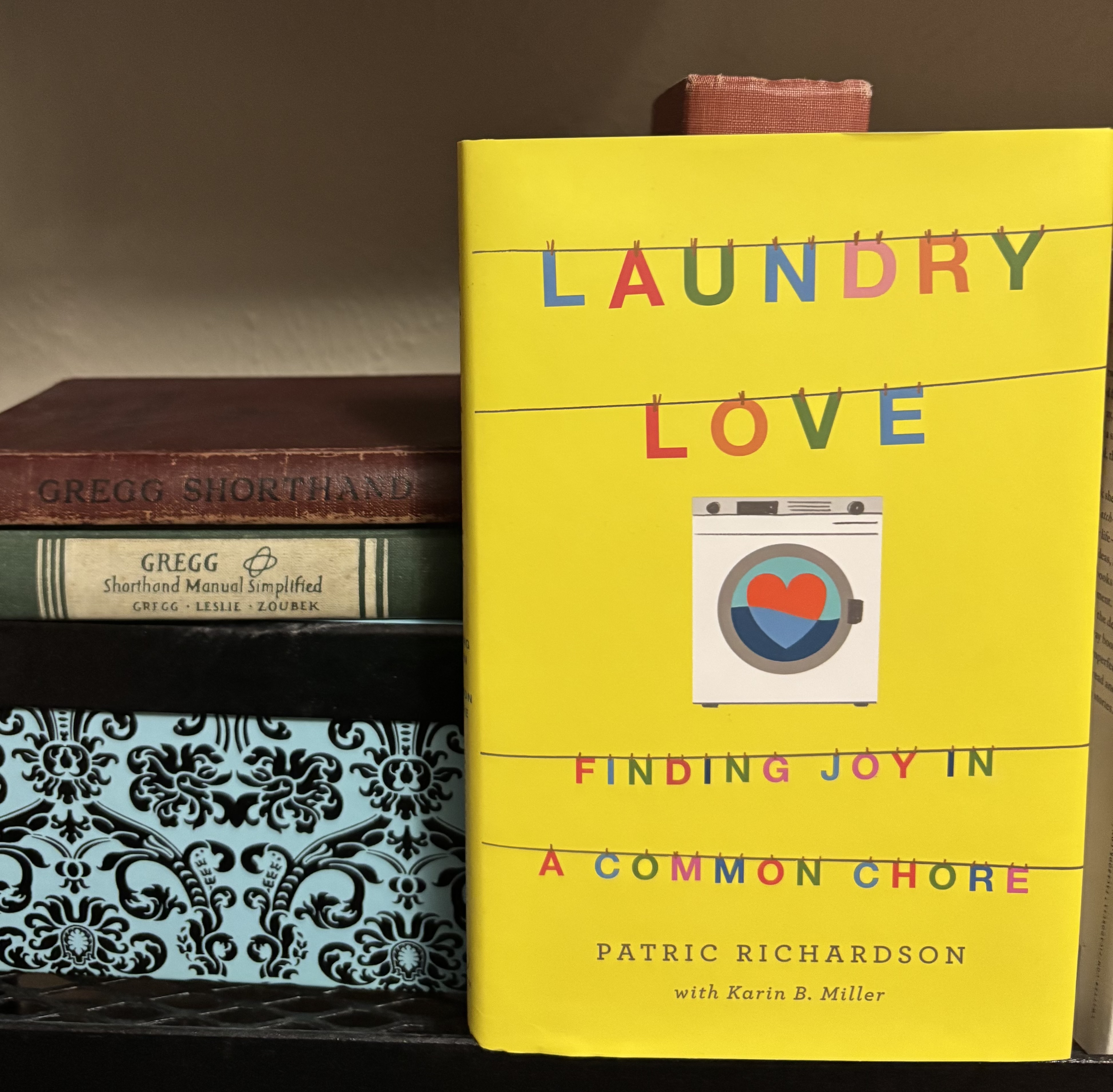
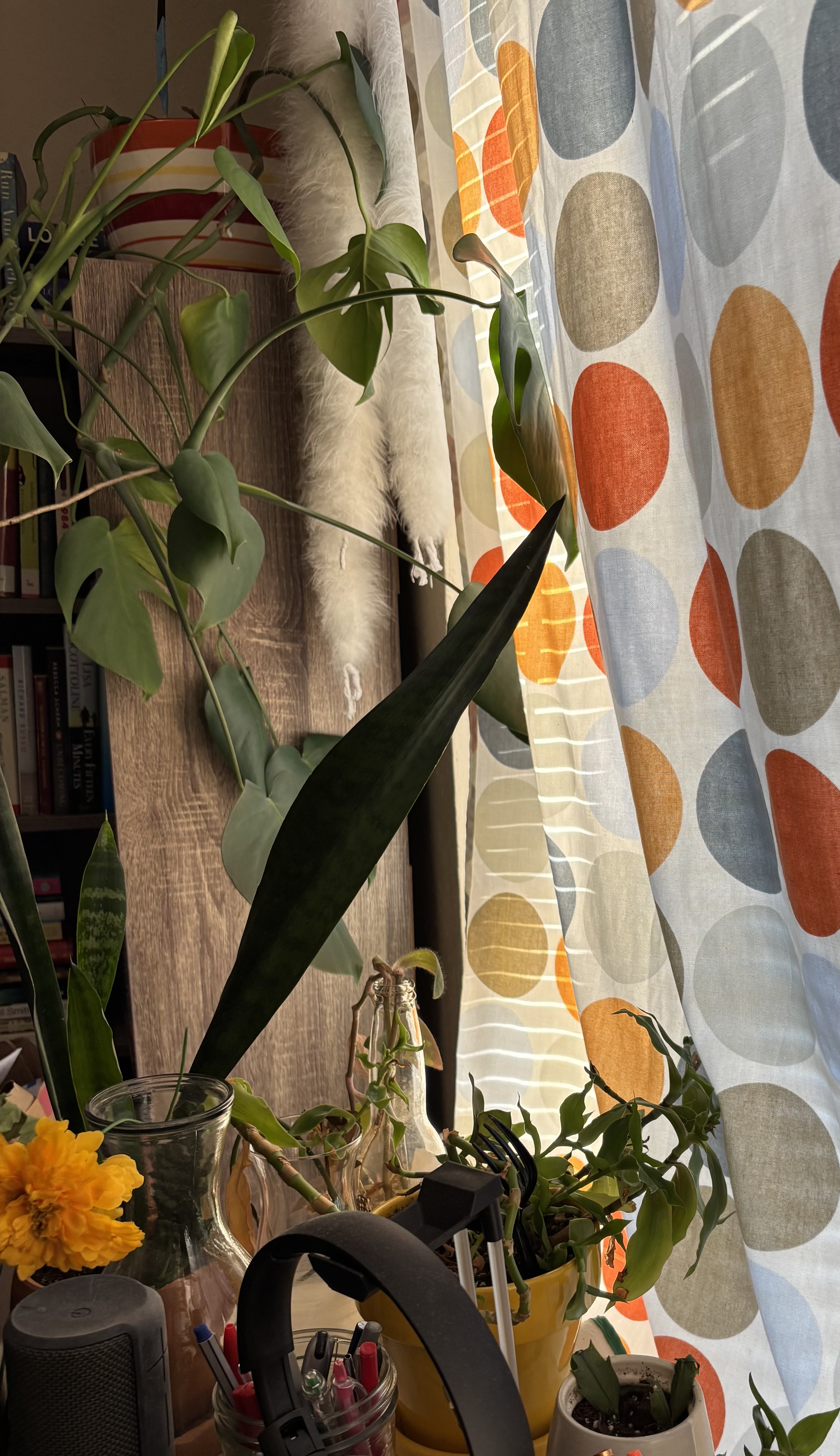
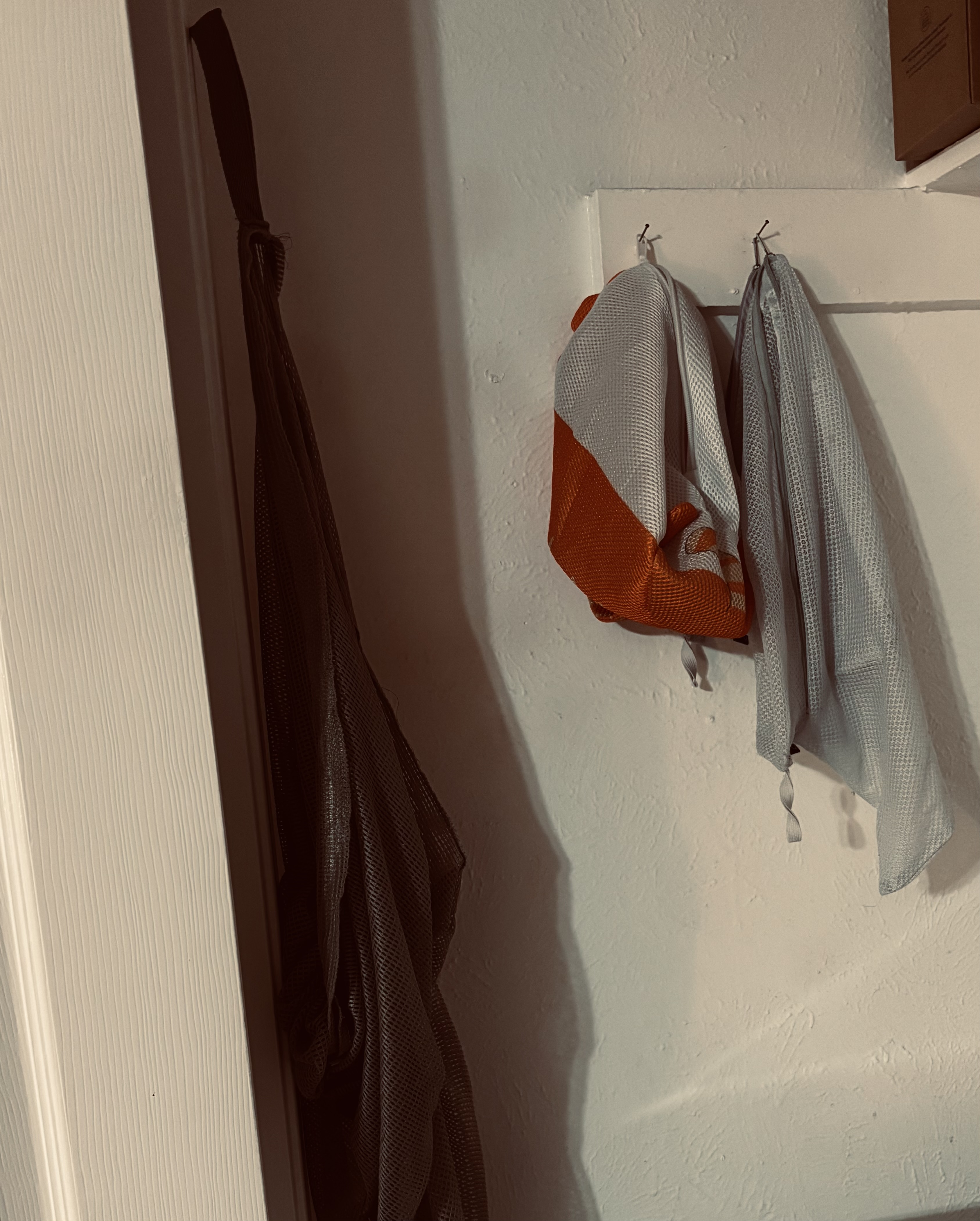
[And yes, all the pictures in the series are of my actual home.]

All the posts to date: