Feeds:
Posts
Comments

Archive for the ‘Feminism’ Category

Let’s take a little trip back in time to when it was actually November.  November has two big things going for it:

– Thanksgiving month!  My favorite holiday with my favorite holiday traditions.

NaNoWriMo! I didn’t finish this year, but I’ve got a new character whom I love.

The weather could have been cooler.  We had way too many days that made it up to 80 for my taste, but so far, Icetember is making up for it.

Here’s what I was into in November:

To write:

My NaNo piece this year started to be YA fiction about a group of five friends (because nobody has done that before /sarcasm).  I am a proud pantser, but having nothing other than names and costuming in mind before starting is not much to work with.  So about ten days in, I decided to start over with stories about Uncle Wallace the Christmas Mouse.

Uncle Wallace is this fellow:

1118131716

He lives under my Christmas tree. He holds a bell in one hand, and a random basket of apples in the other.

1118131717

I want to believe that there is a deep, meaningful reason for the person who created this masterpiece of holiday decoration to put a basket of apples into his hand.  Clearly, Uncle Wallace has stories to tell. He’s just letting me write them down.

So I didn’t make it to 50,000 words, but Uncle Wallace does have a Facebook page.  So there’s that.

I also wrote a couple of blog posts of which I am proud.  I linked up with Sarah Bessey in celebration of the Jesus Feminist launch with this post, and I wrote Going Home as part of Tara Owens’s synchroblog on Coming Home. 

To read:

I finally made it through The Unbearable Lightness of Being.  There were many lines in the book that I liked.  Unfortunately, there were several pages to wade through between each of those lines.  I’m happy I read it.  I’m happier that I’m through reading it.

My book club read Bill O’Reilly’s Killing Kennedy.  The book was fine, but I don’t like his writing style.  I would read some of it out loud and imagine it in his voice, and that made it a little better.  I would watch it as a documentary.  I also read Dad is Fat and imagined it in Jim Gaffigan’s voice, but that just made it funnier.

I jumped on the Divergent bandwagon, and I am hooked.  I finished book one, and I’ll be buying the other two (or, let’s face it – all three – I can’t have an incomplete trilogy on the shelf) to read over holiday break, because the wait at the library is looooong, and I am impatient.

My favorite book of the month was Pastrix by Nadia Bolz-Weber.  I tried to find my favorite quote, but I’d just end up quoting half the book.  I have narrowed it down that much.  This book made me snort-laugh and ugly-cry, sometimes in the same sentence.  That’s pretty much what I look for in any book I read about God.

To watch:

I’ve been into Burn Notice this month.  His accents are sometimes good, but usually terrible.  Just awful.  But he’s so adorable (and sure, also badass) that I just don’t care.

I haven’t watched much else, unless you count the ridiculous number of hours I spent watching made-for-TV Christmas movies with Mom and the Psych marathon of Christmas episodes over Thanksgiving.

To hear:

November was a weird soundtrack of industrial music (…I don’t know), Memphis Blues (I blame Uncle Wallace), and classical music (because that’s what I listen to when I write).

To taste:

November means homemade candy.  It’s my favorite holiday tradition.  Every year, on Black Friday, we do not shop.  We put up Christmas decorations and make candy to share with friends and take to parties.  This year, we made five different candies – Martha Washingtons (coconut and pecan nougat, covered in chocolate – my favorite), Texas Millionaires (caramel and pecan nougat, covered in chocolate), peanut butter bon bons (peanut butter nougat – you guessed it – covered in chocolate), dark chocolate fudge with peanut butter, and buttermilk pecan pralines.  Can you tell my parents have pecan trees?

My dad made my favorite meal this month.  He made enchiladas with flour tortillas (instead of the traditional corn), and he made them special for me by substituting goat cheese for the cheese he normally uses.  I am not ashamed to admit that I ate five in one setting.  I also do not recommend doing that.

What were you into in November? Need recommendations for your holiday break?  I’m linking up with Leigh Kramer – go over and see what everyone else has to say!

Read Full Post »

Sarah Bessey’s book Jesus Feminist came out on Tuesday.  I am impatiently awaiting its arrival.  I spend so much time hovering near my mailbox around post time that my mail carrier might think that I have a crush on him.  It’s likely that my upcoming glee at the book’s arrival will do nothing to combat this hunch.

I came to my Jesus Feminism somewhat backwards.  I grew up in the church, but when I came to college, my what-Jesus-does-with-me wasn’t really defined yet.  Neither was my feminism, but feminism was what I studied, so that came first.  We were Riot Grrrls.  We reclaimed derogatory terms as our own, to be given only the power that we chose to give them. The  oft-conflicting words of Audre Lorde, bell hooks, Susan Faludi, Naomi Wolf, Gloria Steinem, Alice Walker, Eve Ensler, and Andrea Dworkin (to name a few) informed our feminism.  We fought to hear the voices of the severely oppressed, the truly hindered, throughout the world.

We were also the intellectual children of the Battling Simones.  We reveled in the story of de Beauvoir championing transcendence and freedom and Weil’s response that was something along the lines of, “Clearly, you’ve never been hungry.”  We officially agreed with Weil, but we understood where de Beauvoir was coming from.  We understood firsthand the angst of the privileged oppressed.  Most of my fellow grad students and I fell into this category.   We knew we had experienced personal injustices, but we were more acutely aware of the injustices visited upon others.  The white female student and the white male professional working in one of the few fields that, historically, have been dominated by women, were careful not to step on the voices of the United States citizens of other races that still have it worse than others in this country, who were careful not to step on the voices of the international students, particularly the female international students, restricted in their home country, but living, studying, working, and thriving in the elite halls of American Academia, who were careful not to step on anyone’s voice.

We did combat our personal injustices.  We deconstructed power, knowing that our culture’s stingy, finite view of power was short-sighted – that the fear of the empowerment of the downtrodden was based on this stifled viewpoint – and we fought it.  We argued the difference between equity and equality and talked about why it isn’t just a semantic difference – it is a systemic one – and yes, it does matter, particularly to the short-end-of-the-stick folks (and, haughtily implied, to anyone who can legitimately claim to care at all about them).  We railed against our country’s rape culture (or rail, rather – present tense – as it is still, incredibly, fifteen damn years later, something our culture propagates).  There was room to resist.

The implied narrative, though, still insisted that you might not want to resist too loudly because sitting very near to you is probably someone who has it worse, and you don’t want to seem insensitive to that.  They could speak for themselves; they didn’t need you to speak for them or give them permission.  In our field, few things are as silencing as being perceived as insensitive.  Irreverent is okay – even encouraged.  Insensitive is social suicide.  It’s a stigma that, once one is branded with it, is difficult to overcome.

It’s an easy stigma to fall into when you go to church.  Without knowing me, if my classmates heard my stats – white, female, straight, middle-class, Christian, Texan, etc. – they would probably have been more likely to place me on the side of the oppressors rather than with the oppressed.  Even knowing me, after hearing the stats, they weren’t shy about their surprise that I still managed to overcome it all to be a feminist.

My church leaders also didn’t try to disguise their horror that I would identify as a feminist.  It didn’t help that the pastor’s mother had been a staunch, militant feminist who let her indignation make her bitter, so that’s what all feminism meant to him.  It also didn’t help that I probably would have really liked her and told him so. The other elders were concerned that I had been led astray by my education.  I had a lot of conversations that included the words “The Bible clearly says…”  All the gentleness in the world will not help any statement that disagrees with what comes after that ellipsis sound holy.  I practiced nodding a lot, stifling the urge to wonder aloud if we were reading different Bibles, because from what I’d read, my Bible wasn’t super clear about much of anything.

I fear that this post makes it sound like I had a terrible time of it.  I didn’t.  My experience there was mostly positive.  I love them, and they loved me and fed me, and I’m glad I stayed.

They encouraged me to speak my mind. I can’t think of any other time or place in my life where I could say what I was thinking without having to cushion it with disclaimers and defend my intentions.  They trusted me.  One night, while I was riled up, one of the men started to chuckle.  When I stopped and looked at him, he said, “Sorry, I was just thinking that if anyone else said that to me, I would want to clock them.  But I love you, and I know your heart, so I can’t even be mad. Please keep going.”  He heard my soul because he trusted my intentions.

They were not afraid to lay down their privilege.  We had a visitor one night who, when asked how she was, really told us.  She told us about her troubles and the string of boyfriends who had played a role in them, which led her into a spirited anti-male rant.  When she was finished, one of my dear friends took a deep breath and said, “On behalf of men, I’m sorry.  I’m sorry they treated you that way.”  He could have gotten defensive.  He could have let her anger ruffle him.  He chose to make peace instead.

I’m not naïve enough to think that there were no problems.   I know that my experience with them was not everyone’s experience with them.  We didn’t have a lot in common – they were mostly Republican and mostly complementarian and a whole lot of –ists and –ians that I’m just…not.  And I also know that if I were certain –ists or –ians, I might be telling a different story right now.

But this wonderful, weird group of people, most of whom would balk at the label, taught me to be a feminist in the way that Jesus would be a feminist.  They gave me a glimpse of what an infinite view of power looks like when played out in reality.  It looks like love and trust.  They taught me that laying down privilege doesn’t sound like silence – it sounds like redemption and healing.  It sounds like “Thy kingdom come, thy will be done, on Earth as it is in Heaven.”

It is easy to forget that you have a voice when you spend all your energy being sensitive.  You learn to listen.  You learn a lot.  I am a big fan of listening and learning, both of which are almost impossible to do when you’re the one talking.  There is value in keeping your mouth shut most of the time.

With them, I learned that there is also value in opening it.

In Fall 2009, our church stopped meeting.  There were both official reasons and actual reasons for this break up, but I am not going to go into that here, because the “why” doesn’t change the result.  We scattered.  Some of us found new church homes where what we had to offer was helpful to the new family.

I did not.  I found a lot of places to be quiet and absorb and take – places eager to take me in and take care of me.  I did not get the impression that what I have to give would be useful to them, though.  I think I’ve found a place now, but we’re still new, this place and I.  Since 2009, I have reverted to being mostly silent, with random, startling outbursts of loud, not for lack of anything to say, but for lack of a place where what I have to say would be a help and not a hindrance.

But I cannot stay silent.  This is the danger of getting a glimpse of how things could be.  It makes you require it.  It makes you restless until you acquire it.

We Jesus Feminists?  We honor our restlessness.

I am learning to open my mouth again.  I am out of practice, and I’ve been doing it alone for a long time, so what comes out when my mouth is open is often insensitive.  I hate that.  Every time I do that, I want to run home and cry and never go out again and never speak again, because I hate it when I don’t do it right.  I know how difficult the persona of The One Who Doesn’t Do It Right is to overcome.

But I will not go back to silence.

I’m linking up with Sarah Bessey and a whole lot of other people who will not go back to silence, either.  Read them all.


Read Full Post »

So this isn’t specifically about avoiding fast food, but it’s definitely related.

Image

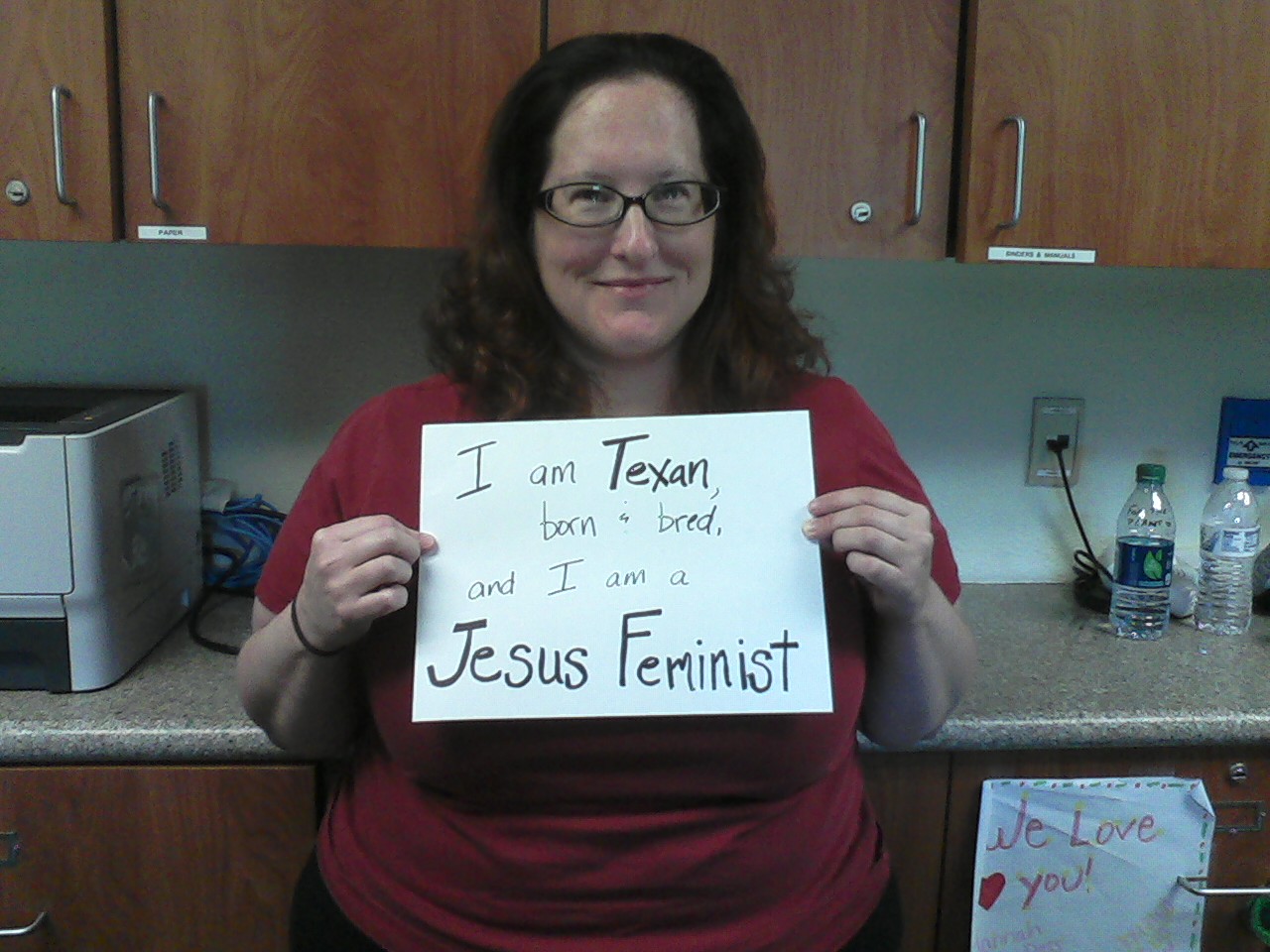
I do not like to have my picture taken.  I especially do not like having my picture taken and then posting it for all the world (or, rather, the hundreds/hopefully thousands who will like the Jesus Feminist page on Facebook) to see.

I do like my Jesus and the feminism he teaches me, though, so I had my picture taken, and I posted it.

But I have anxiety about it.

I do not like that I am overweight.  Mainly, I dislike my weight for the right reasons – it’s unhealthy, it zaps my energy, etc.  I also dislike my weight, however, for the wrong reasons.  I feel bad about myself when I see the “proof” in pictures of how overweight I am.  I feel like a lazy person, because I know that I didn’t exercise this weekend, and the nagging voice in my head chastises me for bad choices and tells me that, clearly, that’s why today’s picture looks terrible.  I think about that shirt that I’m wearing that I don’t really like and find a bit boring but wore anyway because it’s a solid color, which is more slimming than a pattern. I feel like people will see this picture of chunky me in the dull clothes and know that this is why I’m alone.

None of that is true.  I know this.  I’m not lazy – I work two jobs, write in my spare time, and still have time for a life.  Lazy couldn’t do that.  I don’t have to wear clothes that I find dull.  I have many clothes in my closet right now that I love and look cute on me.  And while I don’t really know why I’m single (and frankly, I’m exhausted by the notion of trying to figure it out), I’m pretty sure it has very little – if anything – to do with my weight.  People of all shapes and sizes are loving and lovable, and that includes me.

But oh, the anxiety.

I hope to lose weight for the right reasons.  Losing weight is part of the reason I’m giving up fast food for the month.  What I don’t want is for this pursuit to consume me.  I don’t want to wait to be comfortable in my body until I reach a certain goal.

Themes, observations, and lessons:

– I have body image issues, but I am still a Jesus Feminist, so I refuse to let them define me.

– I feel the urge to do a closet purging.  It’s been a while.  Out with the drab!

– In the not-so-long-ago past, I would have taped this picture to my bathroom mirror in order to inspire myself to eat less and work out.  I’m tired of being motivated by shame, though, so I’m not going to do that.  I need to find a better motivator.

I’m going 31 days without eating fast food.

Read Full Post »

  • {Day 3} What You Learned: On Thursday, February 28, link up at Preston Yancey’s blog and write about these questions: What surprised you this week? What did you take away from the discussion? What blog posts did you find particularly helpful? What questions do you still have?

This week was full of surprises, and all of them were good.

There are so many rich, wonderful voices in the places where feminism and Jesus collide – so many more than I knew.  So many more than I can choose.   Between working and reading, I haven’t slept a lot this week, but my sleep-deprived haze is a dreamy one – the euphoria of living in the magic of a book I can’t put down. FemFest has been that book this week.

This discussion has not stayed quietly on paper (er…screen?).  Several people saw my links on Facebook and Twitter and have stopped by to have conversations or emailed me to continue the conversation.  Many of them have experienced the same Happy Book Stupor that I’ve experienced this week in reading the posts, and they are thirsty for more.  I encouraged them to post their own pieces, and they responded that they didn’t think that they could say it as well as it had already been said.

Let me encourage you again to do the thing that this week has driven home to me the most – this time in writing.  Your voice is important.  What you have to say is important, and no one can speak your mind better than you can.  Speak.  Write.  Dance.  Sing.  Paint.  Play.  Fight.  But join the conversation.

To that end, I want to start a group.  I’m not sure if I want it to be a writer’s group or a reader’s group or both.  I think I would prefer for it to be a face-to-face group, if for no other reason than I make a mean frittata and would love to have another excuse to feed people.  I also think that there are specific things to be done and said where I am that don’t really translate to anywhere else.  But I have met me, so I’m pretty sure I won’t be able to resist expanding discussion via the intrawebs, at least in part.  The group is just a baby idea right now.  Who knows what it will grow up to be?

Step one – gauging interest with my face-to-face crowd.  More to come on this.

Thanks for inspiring me this week, FemFest.  This was fun.

Edited to add – !!!  Congress passes VAWA.

Read Full Post »

{Day 2} Why It Matters: On Wednesday, February 27, link up at Danielle Vermeer’s blog, and write about these questions: What is at stake in this discussion? Why is feminism important to you? Are you thinking about your children or your sisters or the people that have come before you? Or, why do you not like the term? What are you concerned we’re not focusing on or we’re losing sight of when we talk about feminism? Why do you feel passionately about this topic?

Feminism is important to me, because I can’t do it alone. I need the world to want equality in both word and deed – for everyone. And I need feminism, because lately, I’ve been angry.

I want to be hopeful, and I am (sort of) – it’s just not the prevalent force in my life that I want it to be.

I am angry that…

– Too many women still have to work harder to earn the same respect, money, position, or insert-your-desired-compensation-for-work-here that men do, and that’s ridiculous. Don’t know any woman who has had that experience? Welcome to me. I can name four specific times in the last ten years of my career when I have been passed over for a job, only to find out that the man who got the job not only had less education than I do but more importantly, significantly less experience. And I would like to be able to say that those specific men chosen performed those jobs just as well as I would have, so it all worked out, but that’s only true of one of them (who was great at it, and I’m so glad that he got the job). The other three performed exactly how any rational person would expect someone with their limited skills and experience to perform. It’s frustrating enough to lose a job where I know I’d be an asset, but to lose it to someone who does not excel at it is maddening. I’m not naïve enough to think that the choice to hire them rather than me was merely institutional sexism – there were probably many factors involved, some of which were likely my own doing – but I am also not naïve enough to believe that sexism wasn’t one of the factors. And it needs to stop being one of the factors.

I don’t want to seem ungrateful. I do have two jobs that I generally like, while a lot of people are having problems finding any job at all. And there could be more cards stacked against me. I could be a woman AND a minority. I suppose I should see myself as one of the lucky ones. But do you really want to defend the position that working sixty hours a week, just to make ends meet, is lucky? Is that what a system that works looks like to you? That’s certainly not what it looks like to me, and that it works even less for some people than for others is wrong.

– Too many people are bound by rigid, socially constructed gender roles, and their unhappiness that they can’t seem to conform to them, despite constant pressure from church/family/media/society to do so, is unnecessary. I want a world where people can grow into themselves, especially the part of the self where their gender makes sense to them, without being told who they should be and being punished for violating some absurd norm from some imaginary world that was birthed so that the limited number of people who actually fit the stereotypes could feel superior.

– Too many people live in fear. I hate rape culture. I hate that, as a single woman living alone, I have had to take self-defense classes, and that I have various tools that can easily be used as weapons (and yes, I’ve practiced) stashed around my home, and that I have an escape plan – from my own damn home – the place that should be the safest place in the whole world for me – should it become compromised or violated. I hate that I am terrified that I just announced on the Internet that I am a single woman living alone. I hate that education on the subject tends to focus on how not to get raped instead of how to choose not to rape, assuming that prevention is a lost cause or worse – assuming that some people somehow deserve to be degraded. I hate that, twenty years after being a first-year college student myself, our culture is still so stunted in its awareness of this problem that I still have to explain to first-year college students why it matters whether or not they laugh at jokes about rape or abuse – why it is a big deal, always and every time –that that’s how desensitization works and that the complacency created by their desensitization is a big part of said problem. I hate that survivors of violence and abuse are silenced because their real and personal trauma seems like nothing but a big joke to our culture, which leads them to think that no one cares or will believe them and that, more often that you would believe, they’re absolutely right. I hate that rape culture is “just the way the world is,” and I refuse to let it stay that way.

– Too many people – mostly women and girls – are sold into slavery. I need feminism, because sex trafficking exists, and that’s not okay. I need feminism, because it pisses me off to live in a world where I have to say that sex trafficking – specifically, the selling of someone without her/his free consent (i.e., without threat of punishment, abuse, homelessness, ostracism, personal rejection, etc.) – is not okay. I need feminism because this is a problem in my country, in my state, not just “elsewhere.” And if somehow you manage to live in this world and you still didn’t know that, then you need feminism, too, because clearly your churches and your classrooms aren’t even talking about it, and that’s a problem.

– Too much of the world has too many problems, and too few people are whole enough to see far enough outside themselves to resolve them. There are people whose lives are defined by realities that I merely fear. There are people who work themselves to death and still go hungry and homeless. There are people who have to resort to illegal means or means that we, the richest 1% in the world, judge from afar as unethical in order to feed their family, because making an honest living doesn’t actually make a living at all (but it sure does make it possible for us to get great deals at Walmart, so for all our judgment, it seems that, once again, we’re the problem). There are people plagued by disease and poverty who have a voice but don’t have anyone to listen to it. We need to stop being selfish, sexist, controlling, thieving, abusive assholes to one another, because the world needs all the help it can get, and there are only so many hours in a day, and sometimes it’s too much to ask that we overcome our trauma and everyone else’s trauma, too. I am embarrassed that I ever accept that as an excuse not to try.

I am angry that people can see problems right in front of them, hurting people they claim to love,and still not understand or care.

I am angry, because I REFUSE to be apathetic, and most days, those seem like the only two choices.

I’m fed up. I’m tired. I could have written this post twenty years ago, because so little has changed. That’s exhausting. It’s disheartening to work so hard – to teach so much – and see it make so little difference. And I’ve only been at it twenty years. I think of those who have worked toward these goals for two or three times as long as I have, and I sometimes wonder how they get out of bed in the morning.

But between Jesus and feminism (which I suspect Jesus has a bit of a hand in), I have learned how to hope, so I can’t wait until I’m fixed to help others. There might be many pains outside our control, but there are enough pains that are fully within our grasp to alleviate or prevent. So let’s alleviate or prevent them. Let’s all cause each other less trauma. I need feminism (and my Jesus who taught it to me), because at its core is the theme that everyone benefits not only by our being less terrible to one another but also by our being good to one another.

So I am angry. But there is hope. Reading other FemFest posts this week has refreshed some of that hope in me. More on that tomorrow.

Read Full Post »

Here’s the prompt:

“On Tuesday, February 26, link up at J.R. Goudeau’s blog, and write about these questions: What is your experience with feminism? What’s a story or a memory or a person that you associate with that word? Why does it have negative or positive connotations for you? How do you define the term, either academically or personally? What writers have you read whose definitions you want to bring out? Or, if you don’t have a definition, what are some big questions you have?”

Here’s my answer:

The person whom I associate with feminism is someone who probably wouldn’t identify with the label – my mother. She’s the strongest woman I know, and her strength cannot be contained by the boxes of gender roles. She taught me the importance of education (insisted on it, really), the value of honesty (even when it’s not popular or “nice”), and that there is nothing that I want that should be out of my reach. She reminds me of the quintessential Southern woman – self-controlled and genteel on the surface; hell-raiser and in control in reality.

One morning, while helping my sister get ready for church, Mom caught her singing Let’s Go All the Way.

She told her, in the drawl only possible from native West Texans, “T., nice girls don’t sing songs like that.”

My sister quickly ratted us out, as little sisters are prone to do. “S. and G. sing it.”

My mother didn’t miss a beat, as she said, with a barely noticeable smirk of pride, “S. and G. are not nice girls.”

I like that. I’m not sure she meant for me to like it, but I do. I embrace it. She is the voice in my head, and that voice is a glorious troublemaker.

It was that voice that set the stage for my pursuit of a graduate degree in Communication Studies with an interest in gender. Those two years at UNT introduced me to the trailblazers and writers whose work shaped feminism, and I fell in love with all of them. Betty Friedan and bell hooks, Simone Weil and Simone de Beauvoir – their words painted my world. I discovered in Eve Ensler the kind of person I want to be.

I am not an easy feminist. I am one of those annoying ones who see everyone’s voice as important, even those voices that disagree with me. They are all feminism to me. They are all essential. They should all be required reading in any worthwhile education.

I am also a Christian, and this informs my feminism, to a point. This is often confounding to both Christians and feminists. I feel the same need to put an asterisk after “Christian” when talking to feminists that I do to put an asterisk after “feminist” when talking to Christians, because both seem to always want an explanation as to why I’ve chosen to engage with the enemy. I don’t really see them as mutually exclusive, though. I think that feminism and Christianity, at their roots, have more commonalities than differences. I won’t deny that they are often unkind to each other. Maybe that’s what the asterisk is for –to indicate the “not the jerkface kind” footnote.

My definition is not an easy definition. It’s a general definition with infinite applications. My definition of feminism begins at the understanding that all are not born with equal opportunity and thus implies the exhortation that to be a feminist is to equalize, not just for myself but also for others, in any and every way imaginable.

Read Full Post »

This is exactly what I wanted to read this morning.  Enjoy!

Straight White Male: The Lowest Difficulty Setting There Is.

Read Full Post »

These are at least two of my favorite things

textsfromhillary + bindersfullofwomen = WIN

Read Full Post »

« Newer Posts