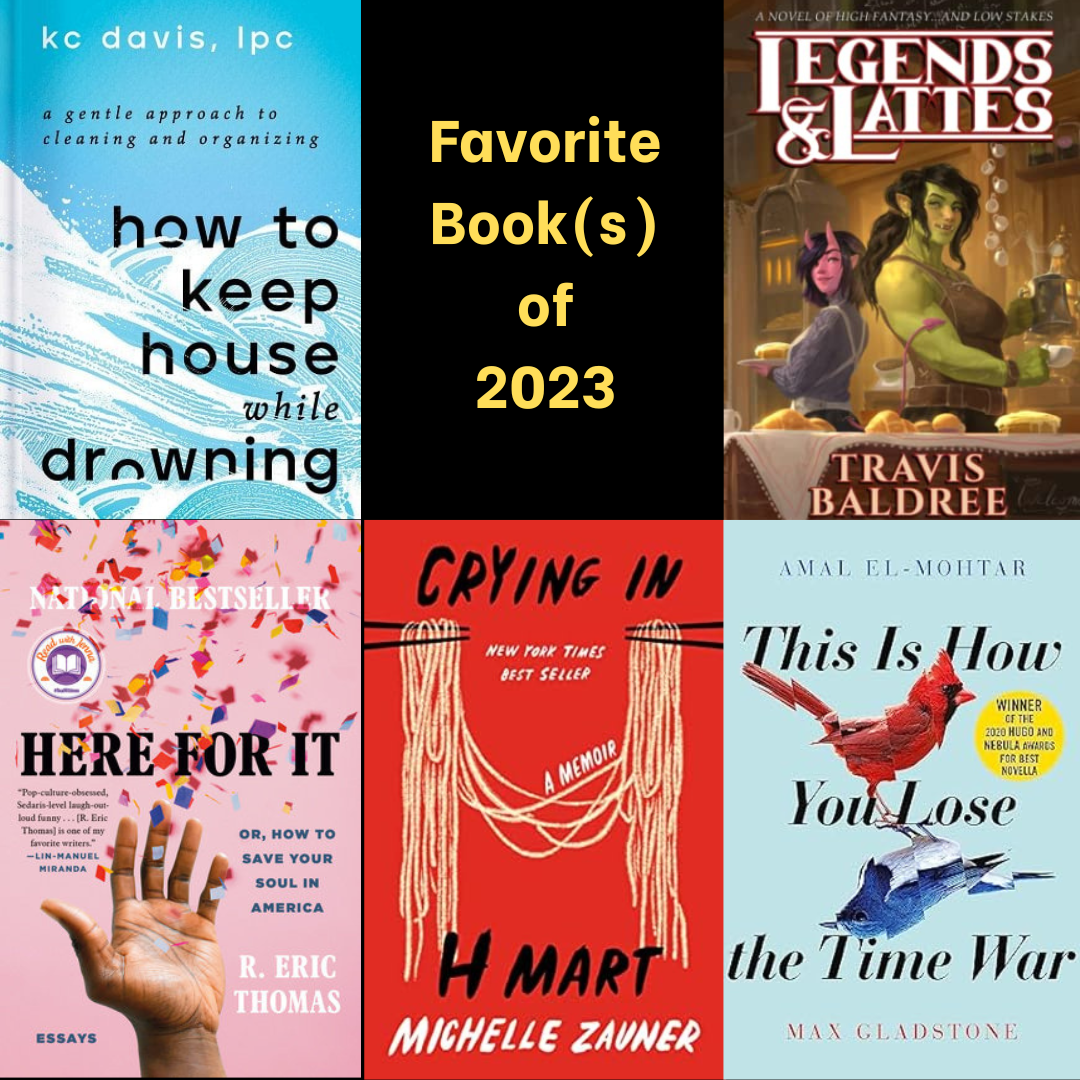
But I did narrow it down to five books. And they’re (for the most part) in slightly different genres.
So there’s that.
When I am choosing the “best books” I have read in any given year, I may not be selecting ones that had the best writing (although all of these are well-written) or were the most profound (although all of these definitely had those moments). The sole factors that determine my decision are:
Did I love reading it?
Did I get something meaningful (possibly even life-changing) out of it?
And out of all the books I’ve read so far this year, these five meet those two criteria the best.
Here For It: Or, How To Save Your Soul in America by R. Eric Thomas – Kind and funny and charming. My favorite parts were the ones in which he talked about his wrestling with faith and identity and how that plays out.
Crying in H Mart by Michelle Zauner – As my parents age, I am more drawn to stories about loss and grief, and this was a gorgeous memoir that explored both as well as the food that reminds her of her mother.
This Is How You Lose the Time War by Amal El-Mohtar and Max Gladstone – Is it a love story? Is it fantasy? Is it science fiction? Yes. In all the best ways.
Legends and Lattes by Travis Baldree – This book made me fall in love with cozy fantasy. I’ve already put the second one on hold at the library.
Paying closer attention to my writing life reminded me that I may need business cards at some point. I’m not quite satisfied with this copy but it’s close.
For the past 12 weeks, I have been experimenting with the concept of a DIY MFA. I don’t have any career aspirations that actually require an official MFA, but I know that there’s so much that I could learn from such a program that would be beneficial to me as a writer, and I am a big fan of lifelong education. I essentially wanted to outline my own class to take each semester, leaning into the wisdom of others and all the rich resources that are out there to improve my writing. Each semester would be 12 weeks long, giving me three courses a year plus a nice break between them.
So I read a ton of the background info on the DIY MFA website (see link above), created a sort of MFA 101 syllabus (gosh, I’ve missed this part of teaching so much), and jumped right in.
There are definitely challenges with trying to teach yourself something that you don’t already know. There are also delightful discoveries.
If I give myself an honest assessment, I would have made a B in the class I created if I had taken it for real from an accredited university. I accomplished the main goal, which was to build strategies for incorporating the following four elements of a traditional MFA into every week:
Writing (putting words on the page to improve craft, creativity, and productivity)
Reading (learning both what works and what doesn’t from the examples of others)
Community (collaborating with writers/artists, connecting with an audience, and/or submitting/performing work)
Education (listening, watching, and reading things to learn how to do the previous three elements better from people who excel at them)
But I didn’t come close to finishing all the things I had outlined to do. I loaded myself up with articles to read and podcasts to listen to (the plan was to mimic a studying/lecture situation), and I made extravagant goals that, looking back, pretty much ignored the fact that I have two jobs and am not a full-time grad student.
I gave myself a ton of resources to get through and activities to complete every week. It didn’t look like that long of a list when I started, but about seven weeks in, out of curiosity, I added up the time it would take to get through the resources outlined in that week’s plan. Almost 11 hours of podcasts alone, which are not my favorite media by a long shot. Before I started this project, I might have listened to one or two podcast episodes a month. And suddenly I expected myself to dive into 11 hours of them a week? Bless my heart. No wonder I was overwhelmed.
Additionally, podcasts were but one aspect of my education that I was trying to fit in. I also listed weekly writing, reading, and community goals that, if completed in full, would have taken at least twice as many hours than the education portion. This resulted in a to-do list that would have been a heavy load even if this project was the only responsibility I had in life.
It was easy to get discouraged by looking at all I wasn’t getting done every week. Upon reflection, however, the reason this typically straight-A student is pleased with the overall outcome is that no semester in a traditional MFA would have been this packed. A 9-hour class schedule in most programs is considered full-time, because it takes into account that, to do well, you will likely need to spend 3-4 times as many hours outside class, reading and completing assignments, as you spend inside class. I went into this as if it were one (3-hour) course, but the syllabus I created was easily the equivalent of a 12-hour graduate workload. That I finished a little more than half of it means I exceeded my initial expectations.
And I loved every minute of it.
Well, most of the minutes. Gonna be more selective and seriously dial back the number of podcast episodes I listen to each week for the next round starting in January. I just…that is not the life for me.
But it forced me to be more mindful of my goals and how they balance. As a result, I’ve written more in the last 12 weeks than I have in the rest of the year combined. I also feel less stressed about decisions about my involvement with my various artsy communities (specifically, those times I want to do something but need to say no) because I now have a better overall understanding of my creative life as a whole. More of that, please.
I also think having an official textbook for each semester would be helpful because then I can choose additional resources that complement it rather than jumping topics so much. For example, the next session’s textbook is Julia Cameron’s The Artist’s Way, which I have been through once already, but I know there’s so much more to learn there. And Cameron’s book is so detailed that the syllabus will basically write itself.
So this first session was a success, even if it didn’t always feel like it at the time.
Last week, I was at the family farm and limiting screen time due to a concussion, but I’m feeling much better now. It’s the time of the year when I’m holiday-ing and transitioning to a new yearly theme, but there are still snippets of home that you’ll see throughout each week’s review this month (and of course, there will be a general review of what the theme has taught me near the end of December).
I love this tour of the place where the writer lives. So much good stuff about home and honoring the generosity of the earth and all its creatures. Read it slowly with your favorite warm beverage.
Did You Hear About Kitty Karr? by Crystal Smith Paul – I would probably not have picked this one up if it wasn’t suggested for a book discussion at work. I’m so glad I did. The pacing was perfect. If I were teaching a writing class, this is the book I would use to show how it’s done. The writer unfolded the story beautifully, revealing just enough to spark interest along the way and building up to big moments with perfect timing. I felt like I was making discoveries along with the main character. I was never bored at any point, and there are not many books that I can say that about.
The Silent Gondoliers by William Goldman – I adored this small book by the author of The Princess Bride. Similar storytelling style – a lot of charm and humor and quirky characters. Fantastical, mystical…it was a lot of fun.
The 12 Week Year by Brian P. Moran and Michael Lennington – This book was about 200 pages, but it seemed so much longer. If you want to brush up on your time management skills, this is a decent guide with solid tips. It’s especially helpful if you’re a person who tends to thrive with short bursts of intense focus and activity. Reader beware, though – there is a LOT of traditional, neurotypical, motivational speaker-y advice on productivity that fell flat with me. If I could hype up or push myself into being more productive, I would have already published 40 books, own a house, be a Pilates instructor, and have a regular workout schedule that seems as intuitive as breathing by now. If you are reading it and find these bits more overwhelming than instructive, it’s ok to put it down.
Y’all. I was looking for my mom’s surprise cookies recipe to take to cookbook club tonight, and I ran across my old blog that chronicled the foodie weekends Maggie and I had. There are only a few posts, and it’s very, very yellow, but it was a fun trip down memory lane. Damn, I loved that kitchen. *moment of silence* Also, I notice that our cocktail weekend didn’t make it to print. That tracks. That was a fun time. And aw, also this one, the blog I had on Blogger for a minute before I decided that WordPress was a better fit for what I wanted to do when Livejournal started getting wonky. Good times.
The weekend is full, but it should also be fun. I hope yours is fun as well!
I had a readathon this weekend, and I forgot how nice and relaxing they are. I needed that. I didn’t realize how much I needed it until I looked at my calendar Friday evening, saw that I only had one additional thing scheduled the whole weekend (dinner at my friends’ house where I was plied with delicious food and wine and got to see their dog Charlie and catch up with them and watch TV – so, even the one thing was super low key), and burst into tears of relief.
Welp, that’s telling.
In mental health news, it has been noted that I am describing a greater number of stress responses than usual in sessions. There are probably several factors. First, it’s the end of the semester, and transitions between application periods always have the potential for instability and extra wackiness. Even when the work week is reasonably calm – like last week was – just the awareness that this time of the year is particularly prone to changing in an instant is stressful.
I am also – once again – trying to do too much and not taking the time I know I need for proper rest and restoration. The writing project I’m focusing on is deeply personal and is uncovering some things I probably need to address in future sessions. And then there’s the ongoing, underlying theme of my brain’s particular neurospicy cocktail, which ensures that common elements in several environments I frequent often trigger an acute stress response, just as a matter of course.
A reasonable question might be, “Can’t you just avoid environments that hurt you?” As we discovered during the stay-in-place times during the height of the pandemic, the answer is yes – absolutely I can. That is technically a possibility that I could put in place if I really needed to, as these responses are rarely triggered at home. But since the aforementioned environments do allow me to do nice things like pay for food and rent or engage in creative pursuits and also socialize ever, they’re not really situations I would want to avoid, even if, technically, I could.
Up until recently, any time someone would mention the concept of fight vs. flight, I would state that I’m almost all fight. But while that may have been true at certain points in my life, I don’t think it is anymore. I still occasionally react in a tight jaw/tense muscles/knotted gut sort of way, but even then it tends to stay bottled up and internal, in ready-to-fight mode. More often, I get fidgety, which is more flight, or preparing to run away.
To my great dismay, though, the most common acute stress response I have these days is fawn. Particularly when the stressor is social. And it doesn’t have to be a big stressor – just something catching me off guard, conflict (even mild ones), someone talking more loudly than I can readily process, a slamming door (i.e., the doors at work all day every day), etc. I turn into this over-the-top people pleaser, which is not at all my usual personality. I switch into accommodation mode, giving the other people/person in the situation whatever they want or letting them control it completely. I become overly complimentary, saying things that, while they are truly what I think, are also in that moment specifically spoken to soothe their stress and, by extension, my own. I do anything I can to appear compliant, non-threatening, gracious, and useful.
These things are not bad ways to be in general. But because I know it’s a stress response, and thus that the intention behind it is more about avoiding further stress than actual helpfulness, it doesn’t feel good. It’s not an honest interaction, but it seems to come across as one. It feels phony, and it’s hard not to judge myself harshly for that, even though stress responses are typically harder (impossible? I wonder) to control. At any rate, it’s my least favorite version of me, especially when I comply by doing something I didn’t actually want to do, but did do, and then felt compelled to either keep pretending that I wanted to or end the madness with an awkward conversation where I say all these convoluted things out loud and utterly confuse/hurt/disappoint everyone involved.
[That last sentence is what everything in my brain sounds like right now.]
Also, my skin hates it when I feel this way, and it’s acting out. That’s annoying. And itchy.
So that thing I was doing during Lent – taking the two time-outs per week instead of just one? I’m going back to that. It requires some creative corralling of my schedule for my second job, but it’s so worth it. I look forward to being myself most of the time again.
What are some things you do (or stop doing) to relieve stress?
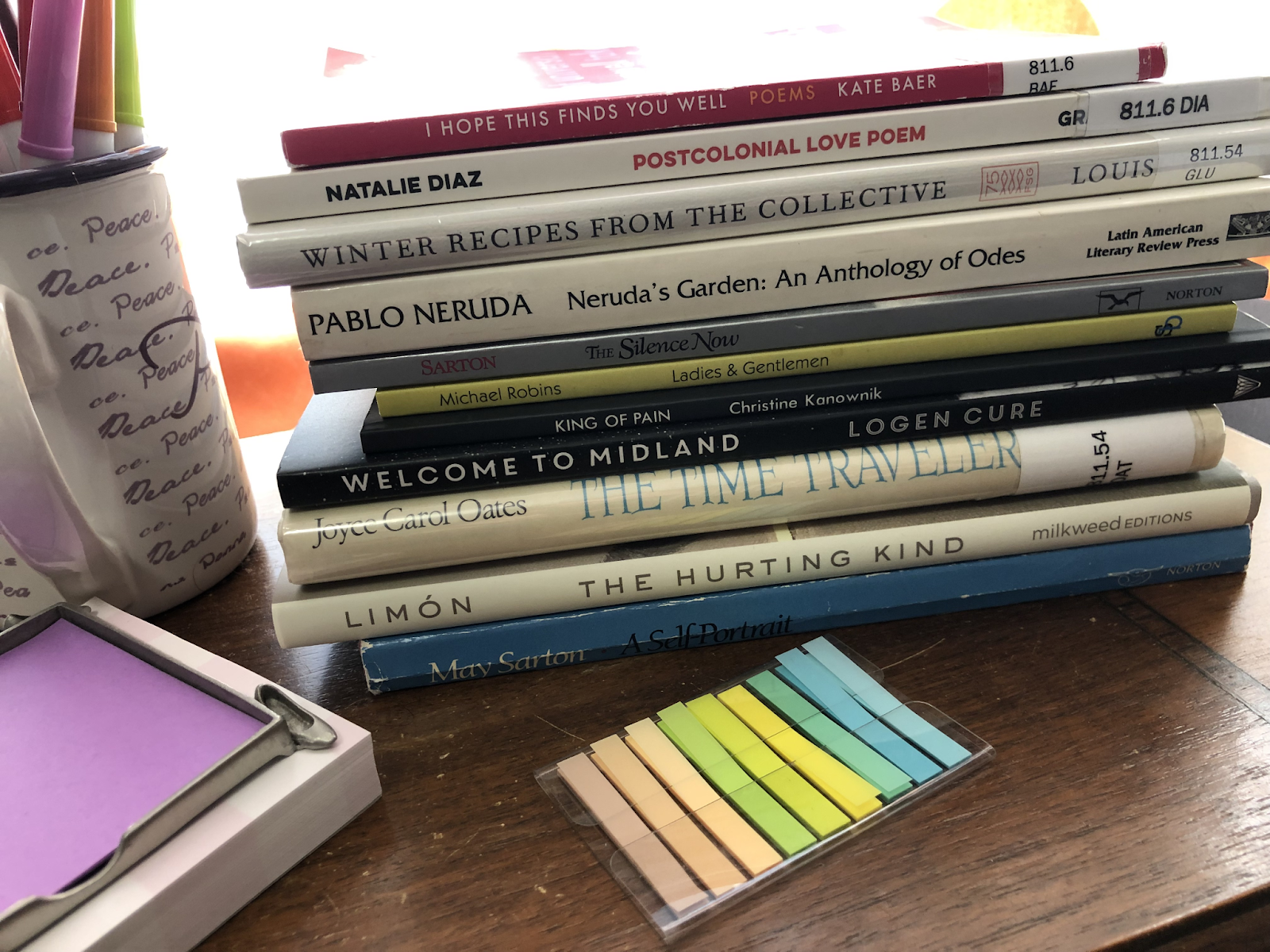
It is National Poetry Month, and the book stack in the office is ready!
In my quest to read 180 books this year, I am consistently lagging behind by a count of two. This is encouraging, because it means that I have at least found the pace that’s necessary to meet my goal – I just need to sneak a couple of extras in there somewhere. And I know there are several pockets of time throughout the year when I typically finish more books than usual.
April is the first of those times.
I know the list this month looks long, but all of the ones listed under my collection section and most of the TBR section are poetry books that I can easily read in a few hours, even as I savor them slowly, recite them out loud, and re-read poems I particularly love three or four times.
Follow the Reader – Choose your own poetry adventure (i.e., read poetry and bring your faves to read to/with the group) – see most of the TBR and Collection selections below
Weyward by Emilia Hart and The Spite House by Johnny Compton for Rise & Shine’s paranormal fiction theme
I Hope This Finds You Well by Kate Baer (Girlxoxo selection – keyword “found” – a stretch but different tenses are allowed under their “synonyms and different suffixes” clause)
One of the things I’ve been doing to streamline my finances this year is looking at all the subscriptions I have and evaluating which ones I use enough to justify the cost. I do use Audible frequently, as I do all my bookish apps and subscriptions, but it doesn’t offer anything extra that I can’t get from:
Libro.fm (which gives a kickback to my favorite local bookstore)
Kobo (which is about 2/3 the cost of Audible)
Scribd (which I love and use the most often)
The audio apps through the public library (which have limited selections but also the shiny, winning element of being free)
Factor in the delight I will experience by putting fewer dollars into the Amazon machine, and Audible is the obvious choice for the chopping block. So for the next few months, I’m focusing a lot of my audio selections on listening to the unfinished books in my Audible library so that I can dump it altogether without losing what I’ve already bought.
I recently rearranged part of my living room because, once I put my Christmas decorations back in the closet, I couldn’t bring myself to move the recliner back to that corner. I like it where it is. So instead, I moved the small table with my record player over.
It works better there. It’s easier to access, and I use it more often now that it’s not hidden behind the couch and a bookshelf and some throw pillows.
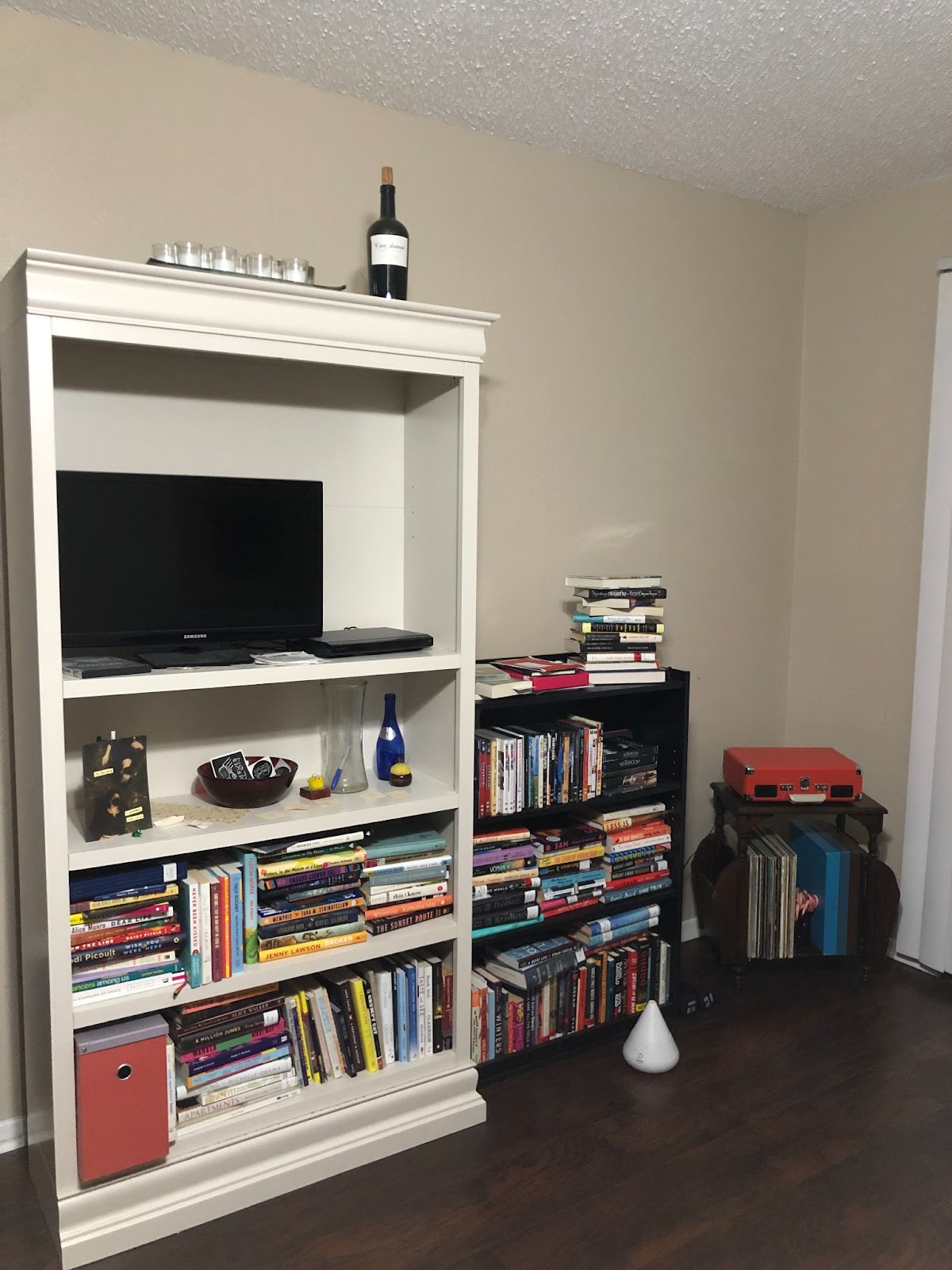
Eventually, though, I want this whole wall to be tall bookshelves, so it and the records will need to move to one of those. I’m running out of space for records anyway. And I want more bookshelves on the opposite wall. Get rid of the couch. Add reading chairs and a lamp in its place. My plans just snowballed from there.
This small move inspired me to take pictures of all four of my main rooms – living, dining, office, bedroom. That way, I have “before” pictures.
But y’all. They are a MESS. The picture above is literally the only one I’m willing to post on the intrawebs. And I’m annoyed with it, too, because why is the diffuser in the middle of the floor. Ugh.
I get used to the clutter when I live in it every day, but looking at it in a picture that I am considering showing other people makes it more real to me. On the one hand, that’s moderately motivating enough to inspire a few tidy sessions in the days that follow. But once that motivation passes, it will most likely just leave me overwhelmed and make me even more hesitant to ever invite people over.
I keep reminding myself that this is a process. But it’s difficult to stay optimistic because I know not only my vision of what I want it to look like but also how very, very many steps it’s going to take to get it there. I yawned and daydreamed about taking a nap just typing that sentence.
So maybe I’ll delete most of those pictures, and I’ll wait to take new ones until I have visual confirmation of having completed one of the steps toward my end goal (like the picture above). Proof of a small move in the right direction is more likely to inspire further plans and their enthusiastic execution than thorough documentation of my overall chaos.
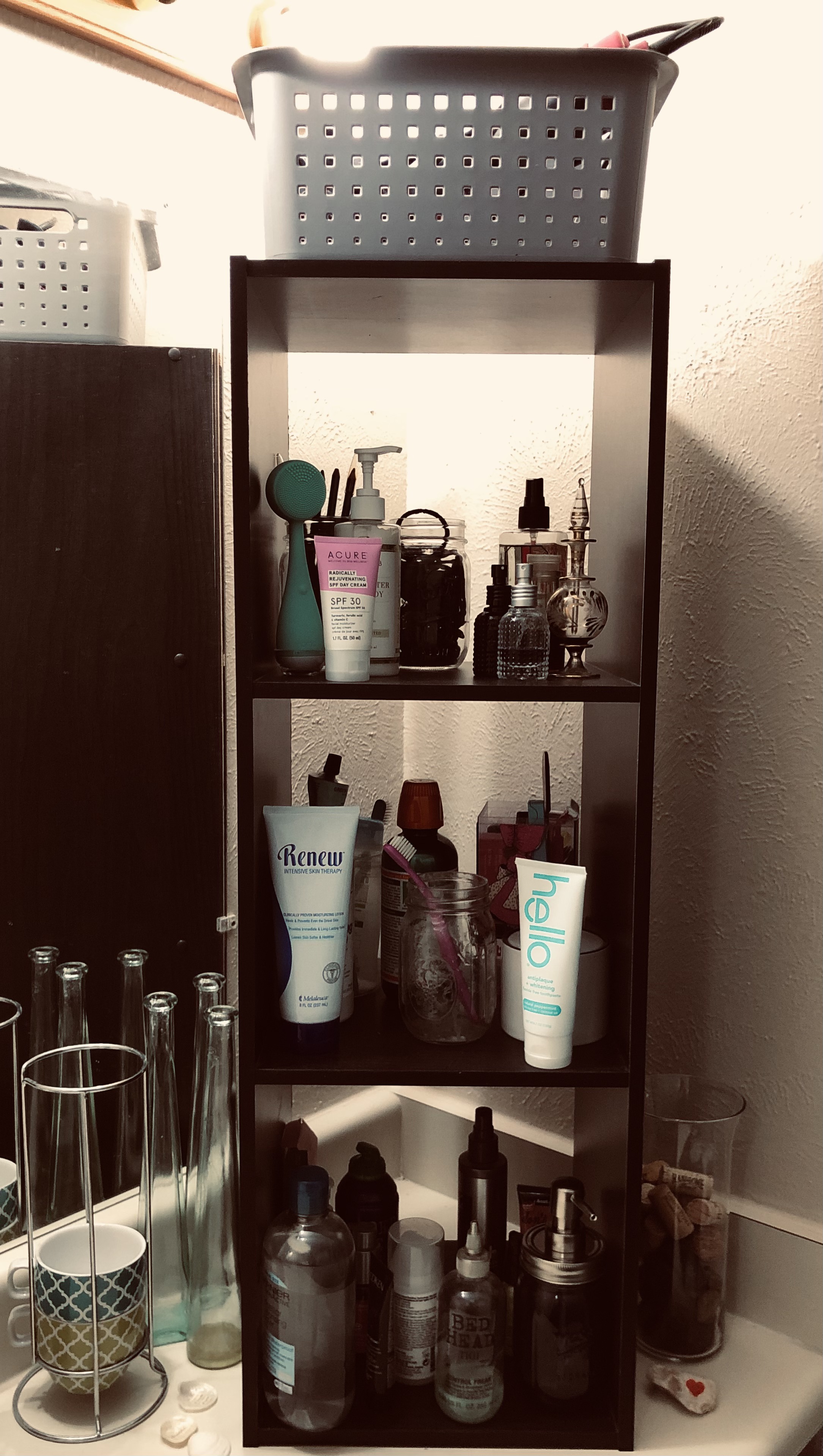
This is not a commercial for the products pictured above. I was just excited about a bathroom storage solution that I will actually maintain on a daily basis. I really like the idea of a cabinet I can close and hide things away in, but in practice, I know that’s just code for “place I can stuff random crap and pretend I’ve tidied.”
When I read The Organized Home, I was finally able to wrap my mind around an open shelf that 1) holds everything I use on at least a weekly basis and 2) still looks presentable. The best part is that I was able to repurpose the bookshelf by my reading chair that was overflowing and replace it with a bigger shelf that was taking up space in my dining area but mostly going unused. Twin wins for two rooms!
I mean, the book had already won me over when it became clear in the first 20 pages that it’s really just a manifesto on how to shove more bookshelves into your home (my design philosophy in a nutshell). But all it took was one gorgeous picture of a bookshelf in the bathroom to spark the idea, and now the space that has been the bane of my existence since I moved in has stayed organized for over two weeks with absolutely no extra effort on my part. Incredible.
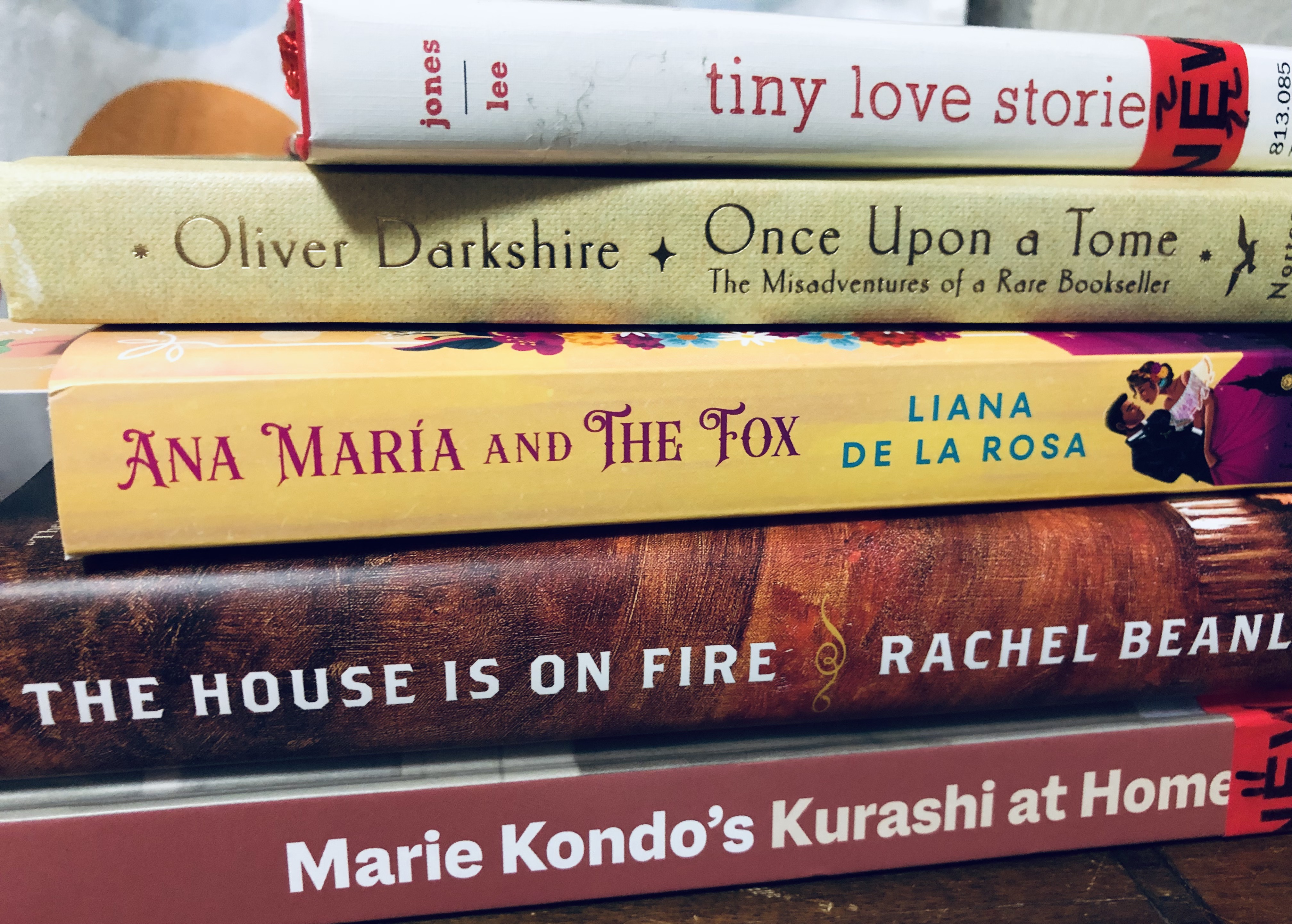
I loooove design and organization books. Because their goal is to make spaces more aesthetically pleasing, their covers are almost always gorgeous. I’m a sucker for a beautiful cover, so it’s inevitable that I will pick them up. And then I start thumbing through, and I get excited about some of the ideas, and ooh – there’s another book, and isn’t the color scheme on the front lovely? Before you know it, design books make up half my library stack that day.
I always think, “Oh, this book is mostly pictures – it will be a quick read.” Ha. No. The actual reading part? Sure. But I am constantly making notes as I go through, jotting down ways to improve some spaces in my home that aren’t quite working for me. And once an idea takes hold that I can apply to my apartment with little to no expense? Forget sitting still enough to read. I’m up and rearranging or revamping, and the rest of the book will have to wait until I’m satisfied with the progress.
I tend to go ahead and buy the ones that match my personal style, because even if some of the ideas in them aren’t useful the first time I read them, I know I will circle back to them later. In the meantime, they look so pretty on the shelf or coffee table.
Do you love design books? What are some of your favorites?
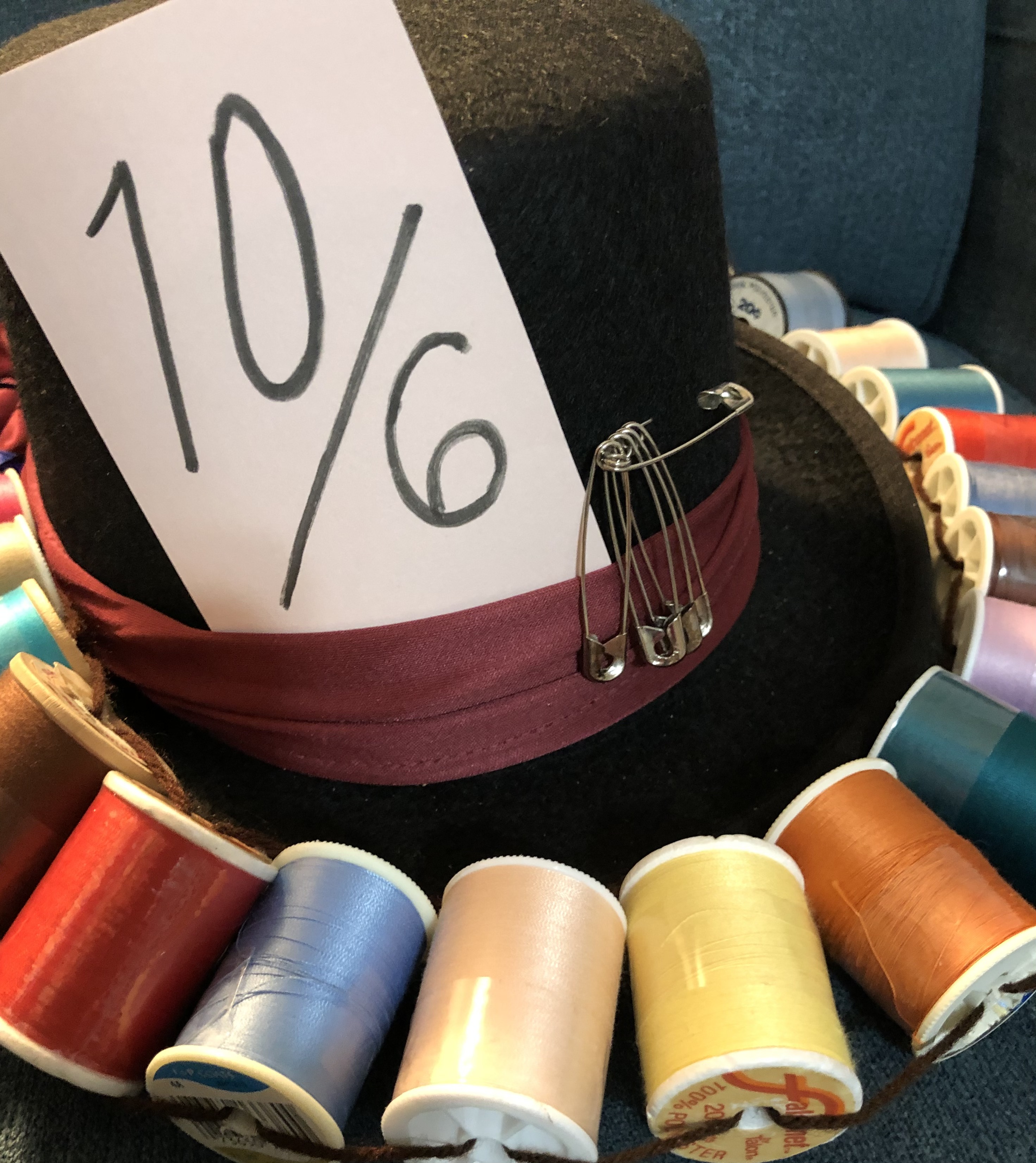
I love costumes. I usually dress up as food (e.g., one year for Halloween, I was a strawberry milkshake), but this year, I am the Mad Hatter. It’s so much fun. The spool sash took forever but is definitely my favorite part of the outfit. One of my coworkers squeals, “You’re so cute!” every time she walks by. I enjoy that.
I can be fairly sensitive and serious, but any chance I get to insert a little whimsy into my life, I jump at it. I love opportunities to be creative, and I notice that I do better mentally when I make an effort to seek them out. To that end, I track creative tasks as part of my ongoing goal-setting for the year. This year, I have eight categories I’m tracking, and while I have specific goals for each (see parentheses below), I try to work most of them in as often as possible:
Writing – My writing job and blogging basically track themselves, so I limit this category to other projects, such as poetry, fiction, and newsletter or journal submissions (at least four times a week).
Needlework – Most of this is knitting, but I also have been playing around with embroidery and cross stitch (at least twice a week).
Piano – I have been working through a book of sonatas, trying to keep my sight-reading skills fresh, but I’m also (slowly) composing a piece. It’s the first song I have written since I busted out “Texas Is the Place for Me” for a piano recital when I was in junior high, but unlike that little gem, this one is strictly instrumental (at least twice a week).
Art journal – I have a lush-themed art journal for the year as well as an ongoing scrapbook sort of thing. I also include coloring in this because most of those pages serve as page backdrops or cover art for my various art journals (at least three times a week).
Cooking/baking – Is cooking creative? It is the way I do it. Also, have you seen Pie Lady Books? But even if it’s not that elaborate, I like playing around with ingredients and seeing how it turns out (at least once a week, but usually more, especially if I have several free days/evenings).
Collaboration – Creative tasks are even more fun with other people. Choir practice and jam sessions are typically how this pans out, but the occasional studio or art party counts, too (at least once but often twice a week).
Performance – I usually sing with the choir in service on Sunday mornings, but I’ve been dipping my toe into being on other stages for the last couple of years. I have a performance coming up in the next couple of weeks, so stay tuned if you’re local (at least four times a month).
Miscellaneous – Dang, I love a craft project. I like figuring out how to build or make things, especially if I can use them to decorate or accessorize. At any point in time, I likely have three or four projects in process, and the only reason there aren’t more is that I am limited on space (at least twice a week).
Speaking of goal tracking, I would be remiss if I did not wrap up this month of writing about creating a lush life without revealing the specific things I have been trying to put into practice on a regular basis this year. I didn’t set a specific goal number for them; I’m mostly just logging them for informational purposes. There are five main categories that I use to track lush living:
Cozy – Big surprise there, I know. This category is super broad. Any day that includes sufficient cozy elements (this category is also super vague) gets a check mark. Mostly, this is an opportunity to reflect at the end of each day on whether I have made time for myself to relax.
Pleasure/self-care – Closely related to cozy (and sometimes they do overlap), this category is more for specific self-care actions like facials and getting my hair done and foot soaks.
Socializing – If left to my own devices, I will hermit away and hardly ever leave the house. But several things I’ve talked about this month involve actually connecting with other people, so I give myself a little shout-out in my goal chart when I do something social.
Journaling – Sometimes this seems like too much navel-gazing (particularly this month when I’m also journaling daily-ish online), but it is vital to my mental health. I’m so much more grounded when I take a little time every day to write my thoughts out. My journals bounce between total stream of consciousness and well-organized, multi-tiered arguments. It’s a wild ride. I may have to appoint someone to burn them when I die.
Adulting – For lack of a better term. I tend to procrastinate unpleasant tasks until I am desperate to get them done. This is unnecessarily stressful and counterproductive when it comes to living a lush life. In addition to putting the week’s to-do list in my planner, I give myself credit for each task in my chart, and it’s working so well that I’m going to keep doing it next year.
And that’s the end. I hope you’ve enjoyed reading this series of posts on creating a lush life as much as I’ve enjoyed writing them. Hopefully, you found the occasional nugget that can help you make your life a little lusher, too.
(Disclosure – some of the links in this post get me some sort of bonus if you sign up. No pressure – just seemed right to let you know.)
I’m not sure when I went from viewing shopping as a nice outing to absolutely despising it. But I’m fully entrenched in avoiding it at all costs these days. I have eaten some of the weirdest concoctions for dinner just to put off going to the grocery store another day. Shoe shopping, one of my former favorite pastimes, is nothing but a chore. And trying on clothes? Forget it. I’ve gotten pretty good at guessing if something will fit so I can just grab it and go.
The only type of shopping I still like is browsing a bookstore, and unless I have a few hours to look around, I usually need the motivation of picking up an online order or meeting a favorite author who’s signing their books to get me there.
But luckily, services such as automated shipments and subscriptions exist. They make my life so much better.
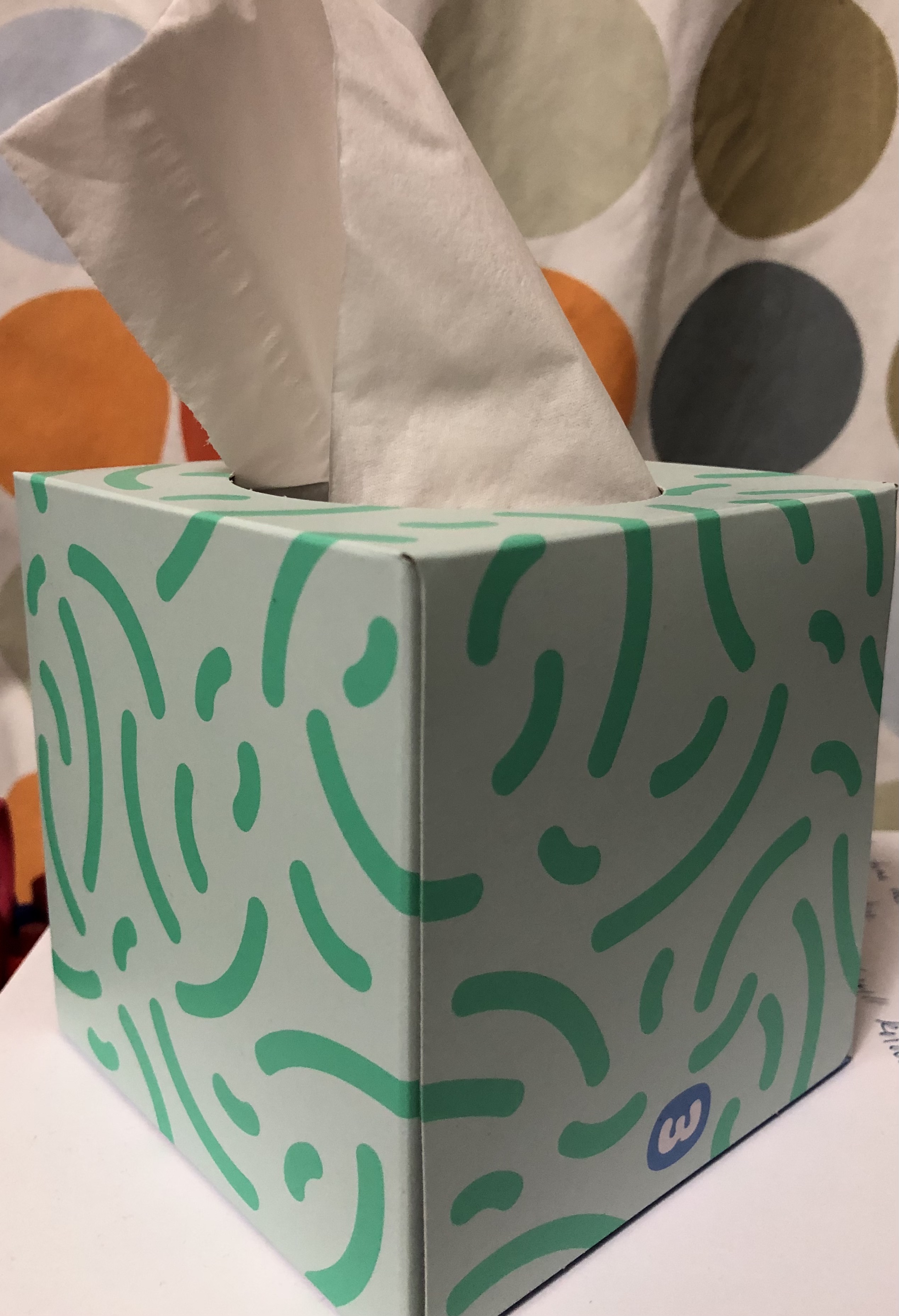
I am part of three book clubs – Literati, Fantastic Strangelings, and Happy Endings – that ship me each month’s selection. All the paper goods I used – toilet paper, facial tissues, the occasional roll of paper towels – are on timed shipments. So are most of my toiletries and cleaning supplies. I order coffee and tea online (or pick up supplements at church). I don’t remember the last time I went inside the liquor store, because as it turns out, they will all bring my order right to my car, as will the grocery store (when they manage to get the order right).
I’m looking for a reliable way to have all my pantry staples routinely sent to my doorstep. Do you have a service you like? Leave it in the comments. Pretty please.
Part of having a lush life is finding ways to make tedious chores easier (or outsource them altogether). Subscriptions take so many errands off my to-do list, and I love that.
When I think about my ideal lush home, I see fresh flowers on the table. Endless bookshelves. Oversized, comfy chairs with warm blankets draped over them and plenty of large throw pillows to cuddle or use as floor cushions. A place to put my feet up.
Then I look around me, and I see a side table full of tea cups that haven’t quite made it to the kitchen to be washed yet. Dishes piled up in the sink. Dust bunnies lurking in the corners. And omg, the piles and piles and PILES of paper.
I was talking to my friend Stephanie lately about the challenges we both face when it comes to maintaining a clean and tidy living space. It was a cathartic conversation, and she shared some helpful resources she’s been using lately. I’ve also been reading Susan Pinsky’s Organizing Solutions for People with ADHD, and it’s been useful, too. This step-by-step approach is helping me work through my overwhelm, and I’m so grateful.
Because nowhere in my vision of a lush life is a messy apartment. I find mess distracting and frustrating, but I can’t quite seem to get a handle on it. I’ve had problems with this for as long as I can remember. Every Saturday, I would complete my assigned housekeeping task for the house (vacuuming) and then spend the rest of Saturday working on my bedroom. And it would look very much the same hours later than it did when I started. I always thought I was just lazy or too busy, but I’ve since noticed that I spend just as much time (if not more) working on my home as others. I get distracted, so there are a lot of half-done tasks strewn throughout my space. Then I get overwhelmed and suddenly every unfinished job seems to have ten times the number of steps than it did before. Then I sit down and binge-watch a familiar show until the pressure subsides, at least until I notice how much is still left to do. Then the cycle repeats.
Part of my goal this year has been to find ways to break this cycle and create a maintenance plan that works for me. I track six general cleaning categories – dishes, laundry, trash, bathroom, tidying, and miscellaneous (which includes any task, such as dusting or vacuuming, that won’t ever need to be done every day) – and I try to check off at least four a day. It doesn’t matter how much time I spend on each of them as long as I can see that none of them are being neglected for more than a day or two. It’s been working much more slowly than I would like, but it has been working, and that’s the important part.
Another resource that helps is this post that reframes cleaning as a hygge activity (there’s also a Facebook group). Lots of inspiration and motivation. My perfectionist brain tells me, “You shouldn’t have to be motivated to adult properly,” but my functional brain thinks my perfectionist brain is an unhelpful asshole and needs to shut it.
[It’s ok to tell the nagging, judgy parts of your brain to mind their business. Shame has no place in this plan.]
Trying to fix the things in my life that haven’t worked for a long time is challenging (and sometimes exhausting), but it’s all part of creating a lush life.



 M. Suzanne Terry