Feeds:
Posts
Comments

Archive for the ‘31 Days’ Category

One of the first “adult” novels I read was Danielle Steel’s Fine Things. I was probably 10 or 11, it was summer, and I was restless. We went to the library once every week or two, and I checked out the the maximum number of books I was allowed (whether by my mother or actual library policy, I don’t know), which was ten. I had exhausted my library selections and had already re-read my own small collection numerous times. So I went to Mom and uttered the two words we knew better than to ever say –

“I’m bored.”

Usually, this declaration received an enthusiastic vow to find us something (usually cleaning-related) to do immediately and for many hours into the foreseeable future. As much as I hated washing the wooden baseboards, though, I was desperate.

I was a reader without a book. In a word – ennuied.

Instead of the usual to-do list (which she mysteriously happened to always have on hand), Mom suggested I read. Like I hadn’t thought of that. When I explained my dilemma, she proposed an alternative. Why didn’t I choose something from her shelves?

Anything?! I marveled. I can choose anything there?!?

Apparently so. If I could reach it, I could read it. I darted out of the room to begin my feverish search before she changed her mind.

I’m not sure if she forgot that she had the romance novel on a lower shelf or if she really was ok with me reading it at my tender, pre-pubescent age, but Fine Things was the main book that stood out to me (Sins of the Fathers by Susan Howatch was also a contender).

In it, I discovered a whole new world of people interacting in what seemed to be (to my young, sheltered eyes) scandalous and brazen ways. Of course, my delicate sensibilities did not deter me from reading. I was hooked from the very beginning.

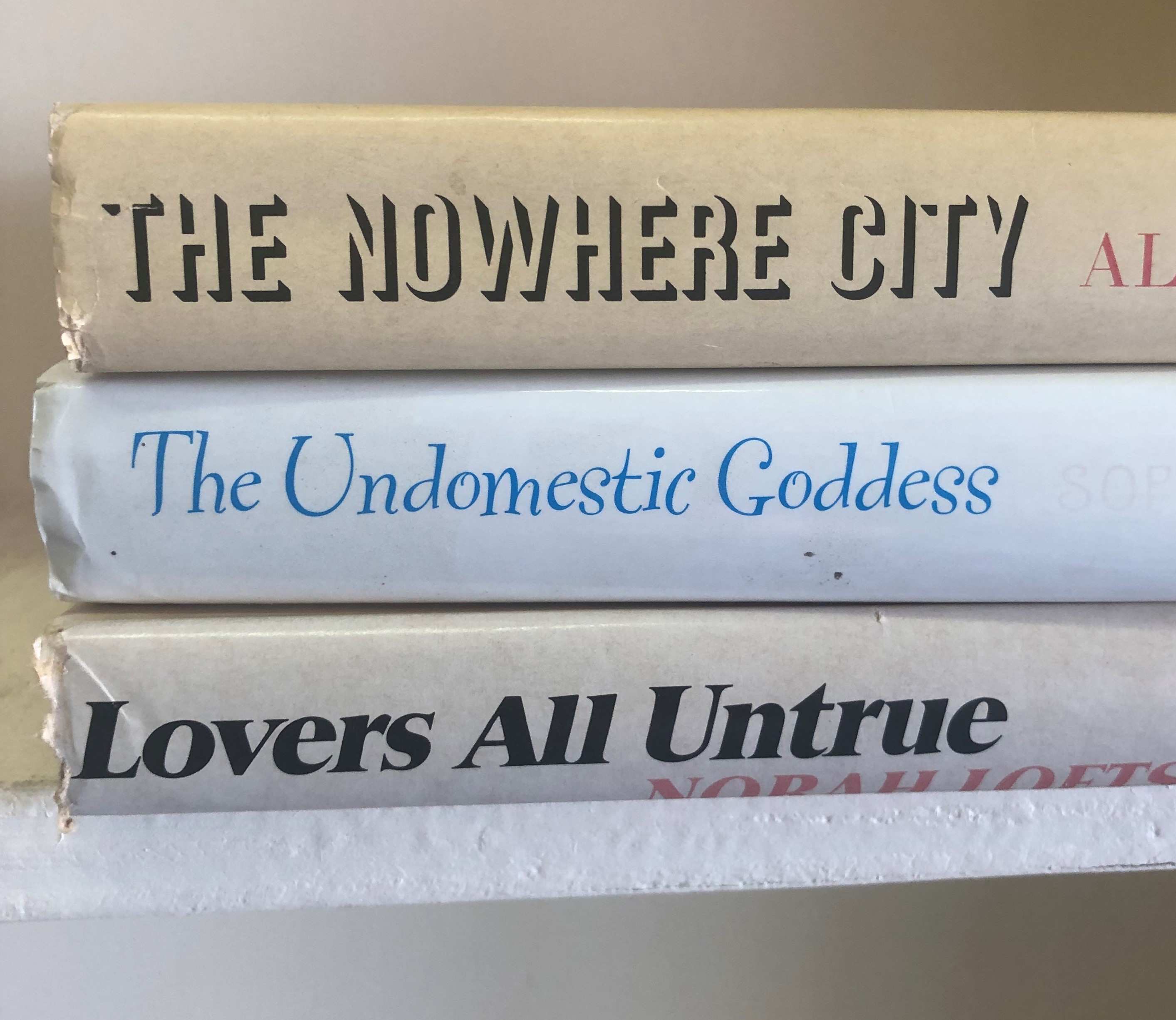
I’ve never considered romance a favorite genre until recently, but that may just be because I didn’t consider a lot of the books I read with romantic elements to be Romance ™. Is Chocolat a romance, or just a delectable story about opening a pâtisserie in a small town in France that happens to include some love connections? Does Nina George write romance, or are the books and the food the real love interests in her stories? Surely Jasmine Guillory (start with The Wedding Date) and Helen Hoang (The Kiss Quotient) are romance. I can’t wait to tuck into my next Alyssa Cole (How To Catch a Queen was pretty hot) and, while not set in contemporary times, all of Outlander as well as Bridgerton are on my TBR list. I also am a fan of Jemima J (and other Jane Green books) as well as the occasional Sophie Kinsella (The Undomestic Goddess pictured above is one of my favorites of hers).

I think part of my decision to embrace my love of romance novels is that I’d rather call these books “romance” than “chick lit,” a term I’m not super fond of. Because you don’t have to identify as a chick to love a good meet-cute (or a steamy sex scene). Both romance and chick lit genres have been the targets of disdain for “serious” readers (whatever in the world that means), but I don’t give that attitude a lot of credence either.

Whatever you call it, I love it. I read a fair amount of difficult topics, but I also like a tidy ending that promises years of happiness to come for the characters I’ve spent the whole book rooting for.

I’m spending October writing about the books I love (and hope to love in the future).
Read Full Post »

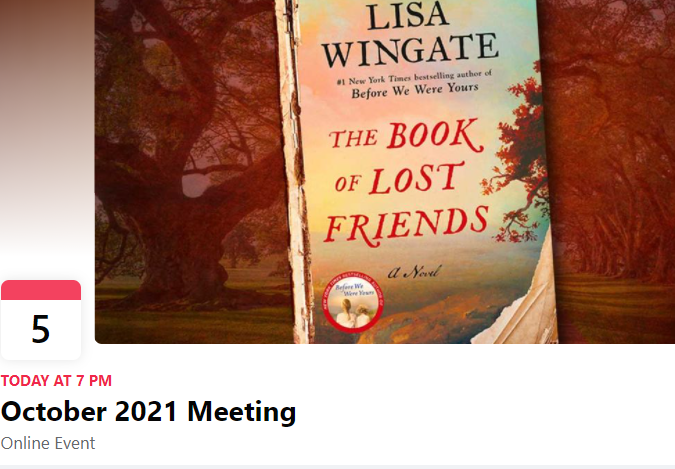
My first book club of the month meets on the first Tuesday, so tonight is our meeting for October. We’re discussing Lisa Wingate’s The Book of Lost Friends, which I am enjoying. If you like historical fiction, particularly regarding the post-Civil War era and the plight of enslaved people during/after/seeking emancipation, give it a read.

This was the first book club I joined. It kinda set the standard for how laidback I like a book club to be. The person who hosts it is a friend from grad school, and pre-pandemic, we met at her house. We’d each bring food to share. Sometimes there was a theme, but mostly it was a motley potluck of whatever sounded good to us. There are a couple of great bakers in the group, and the host kept an emergency cake in the freezer, so there was always at least one dessert. The other common offering for meetings was plenty of wine. We have met online since March or April of 2020, and while I miss the delicious food spread, I love that we can include members who have moved away through Zoom. Also, there is still wine; it’s just in our own houses.

I appreciate that we don’t have to finish the book to be welcome. In fact, when the reminder went out a day or two ago, someone automatically replied, “I have 140 pages to go!” I also have not finished it yet, and the meeting is at 7:00 p.m. (I can do it! I think!). The unofficial rule on spoilers seems to be that we will try not to give too many details away if someone who hasn’t finished is intent on doing so and doesn’t want to know what happened, but that’s not usually the case (for the record – I personally don’t mind spoilers. They don’t take away from my enjoyment of a book, show, movie, etc., at all). We always talk about the book a little bit, but unless it was super juicy and we all finished it, the actual book discussion is usually short.

The best part of this group is getting to know and staying in touch with these amazing women. We keep up with what’s going on in each other’s families/lives. We share advice when it’s wanted and take each others’ sides in rants about work, difficult family members, and bad customer service. We give each other book recommendations and take bets on which of us will/won’t like next month’s selection. Also the host has a little free library on her porch and will pull books that she thinks we’ll enjoy to put aside for us.

I love having these book friends in my life.

I’m writing about books all month – click here to see the master list!

Read Full Post »

Book spine haiku

I love sharing what I’m reading with other people, but other people don’t always care (or at least not as much as I do). I’ll start to fangirl over the latest book I’m reading, and they’ll nod and smile and listen for a few sentences. Then their eyes will glaze over, or they’ll start looking around like they’re searching for someone – anyone – else to talk to, and their part of the conversation will start to sound like, “Huh,” and “Uh-huh,” and “Oh, wow.” So I finish the sentence I’m on and set them free.

My book clubs, though, give me plenty of space to say everything I want to say about not only the things we’re reading together but also what else we’ve all been reading since the last time we met. We share recommendations and lend each other our own copies of things we think someone would particularly like. If you enjoy talking about books at all but also notice that sometimes when you do, people look like they want to run away, joining a book club may be just the place for you.

The trick is finding one that matches your book club personality.

Not all book clubs are the same. Some focus on the more social aspect of the gathering, while many are super serious about dissecting the plot devices the author used in the novel. And unless you start it yourself, the expectations for how discusssions are going to go have already been set, and they’re unlikely to be changed by a new member. The best way to find a book club you enjoy is to look for one with the structure you like.

There are a few key factors to consider when you’re trying to match your book club personality to an existing group:

  1. Are there snacks? This may not seem like it’s related to the discussion at all, but the presence (or absence) of snacks, how many snacks there are, and who provides it all tell you some things about the expectations of the group. An elaborate spread, dinner, or potluck, complete with wine or other festive beverages, probably indicates (with one key exception I can think of, as you’ll see below) that this is mostly a social gathering that happens to have reading as a theme. If the conversation veers from the selection you’re discussing that evening, that’s probably not a big deal to anyone there. Coffee and tea with a few light refreshments provided by the host, on the other hand, probably indicates that they expect the discussion to be mostly focused on the book or genre scheduled, but they want you to feel welcome (or at least awake on a Saturday morning at the library). No snacks means serious business. You don’t have time to eat or drink anything – you have plot and characters and symbolism to discuss. Also, if you had food, you might spill on the book, and they wouldn’t like that at all. The only book club more serious than one without any food or drink is one with themed food and drink (and also maybe costumes).
  2. Do you need to have finished the book to attend? This is the main factor that matters to me. Even as someone who almost always finishes the books we discuss each month, sometimes I need the option not to. First, life is too short and there are too many good books out there to struggle through one I’m just not enjoying. But I still want to hear what other people liked/disliked about it. Second, a great book club for me is always going to be about more than books. Book people are my people, and I’m theirs. Meeting with them each month is one of my favorite parts of my social life, and I don’t think I’d be comfortable with the idea that I’m only welcome if I’ve done the homework. You, on the other hand, may think that reading the book should be the bare minimum expected of attendees. After all, if you want to delve deep into the discussion of the book, it can be a bit of a bummer if others weren’t even interested enough to finish it. Knowing where you stand on this issue before you look for a book club to join can save you a lot of frustration.
  3. How is the discussion structured? This question speaks to the practical aspects of the meeting, including how long you spend talking about the book, who leads the discussion, and how you know when it’s finished. You may be looking for long, relaxed evenings where you start by talking about what everyone liked about the book, which turns into a discussion about how it compares to other things you’ve read, which turns into musings on how it challenged or changed your perspective and what it means in the grander scheme of your life, culture, or the world. Perhaps you just want a short, casual meeting with other readers structured by a list of 10-15 questions designed to spark discussion about the book you all read before you go on with the rest of your day or evening. Other book clubs choose to just play it by ear, so the actual time you spend discussing the book can last ten minutes or two hours, depending on how much everyone has to say about it. If you have a definite preference, it won’t take long to decide whether a particular book club is right for you.
  4. Are you a good fit for the personalities in the group? I once attended a few meetings of a group formed through a local bookstore. I was drawn to it because the focus they advertised was on feminist themes in classic literature, which sounded like it was right up my alley. It didn’t take long for me to realize that we weren’t a great fit, though. The members were enthusiastic, smart, witty, and friendly. They were also mostly professors or grad students in various English programs in the area, and they clearly didn’t want to avoid (or explain) the jargon known to those in their field in order to be more inclusive. They also did not appreciate my thinly veiled disdain for their insistance that some books are literary and some are not (implied – fluff, less than, not for serious readers). My tastes veered a little too much in the direction of the experimental for them. I think we were all relieved when my schedule suddenly “changed” (i.e., I intentionally made other plans those nights). But that’s how it goes. Just like with any other social group or relationship, sometimes everything looks right on paper, but it just doesn’t work. It may take a few meetings to figure it out that you belong, but once you do, it’s wonderful.

If you want to join a book club but don’t know where to start, this post gives a lot of great suggestions. Then it’s kinda like dating. You go out with a few of them until you find one (or three or four) that works.

What kind of book club do you enjoy?

I’m talking about books all month long!

Read Full Post »

Lovely tracking journal from Anne Bogel (aka, Modern Mrs. Darcy)

A big part of my reading life is taking notes – on what I’ve read and when I read it, how much I liked it, what I want to read, etc. Maybe someone out there is wondering, “But…why? Isn’t reading enjoyable enough on its own?” Well, yes. I loved to read long before I actually kept any sort of records about it. But why settle for enjoyable enough when I can heighten the enjoyment? That’s what tracking does for me.

There are several reasons why I track my reading habits and goals:

  • It helps me stay out of the reading rut. Left to my own devices, I will grab the nearest thing to read and plow my way through. When I do this, I tend to gravitate to certain types of books. There’s nothing wrong with that, of course, but after a while, even my favorite genre starts to seem like homework if that’s all I’m reading. Actually planning my reading and keeping track of what I’ve finished helps me head off staleness at the pass so that I am more likely to stay engaged.
  • Related to the first point, tracking my reading helps me ensure that I’m not just sticking to my comfort zone by gravitating toward authors who tell stories that are similar to my own. One of my favorite benefits of reading is that it constantly fine-tunes my ability to empathize and appreciate other people’s perspectives, and maintaining some diversity in my selections is a good way to aid this process. 
  • Tracking gives me better recommendations. I love tracking through Scribd, because when I rate something highly after I finish it, it updates with suggestions for other books I might enjoy. So what if my TBR list is so long I’d never finish it in 10 lifetimes? I like having well-curated choices.
  • Keeping up with what I’ve read also helps me offer better recommendations to others. Inevitably, upon learning that I love to read, people will ask, “What’s the best book you’ve read?” First, how dare you ask me to choose just one. Second, off the top of my head? I have no idea. I can gush at length about one of the books I’m currently reading, but if a person (or one of my book clubs) is actually looking for something I liked that they might like, too? I’m going to pull up the trusty Goodreads app and peruse my personal reading challenge lists and filter through until I find something I think they’ll enjoy. 

In March 2020, when everything shut down, I found myself going through my planner and crossing out all the plans that were getting canceled. I tried making it festive by putting stickers over them, but the novelty of that wore off quickly. So as the fresh pages of new weeks appeared, I just started using my planner as my TBR list. I limited it to my notes section in my 2021 planner, but it was already full by the end of August. Now I have a designated book journal that I carry around. 

I also just got the newly released book journal by Anne Bogel (aka Modern Mrs. Darcy, queen of book lists) called My Reading Life. I have started thumbing through it and think it will be an excellent way to track at least the books I read for book club, as the tracking pages each have a notes section. She also gives tips for leading book club discussions (which is great – because I’m not awesome at that), her own tips for overcoming ruts, suggestions for setting reading goals, and, of course, more TBR lists. I look forward to using it!

Do you track your reading? If so, what’s your process like?

Read Full Post »

Day 2 – October TBR

The TBR list grows exponentially. As much as I’m reading these days (for example, I finished 15 books in September), I still don’t usually make it all the way through my monthly TBR list. I’m ok with this. I look at these lists more as a “I’m going to start these books this month,” which is a better portrayal of what actually happens. This is how I get 40 books on my “currently reading” list on Goodreads, because I start them and then don’t take them off until I either finish them or decide I’m not interested enough to do so (rare, but it happens). 

So here are the things I’m interested in starting this month:

Joy

The joy selections this month are books I meant to start in past months but haven’t quite yet:

Community Reading

This section used to be reserved strictly for book club selections, but I find that the same spirit of camaraderie exists in less structured book discussions. So I’m also including things that I and a few book-loving friends are passing around (and thus gushing about together), things I’m reading for work, etc.

Additional Reads

These are books I’m may start/finish because they’re the next up in a series (big fan of series – more on that later in the month) or because someone is waiting for them so I have to take them back to the library soon or simply because it’s spooky season so I’m in the mood for witchy/gothic/horror/suspense themes.

It’s also likely that I’ll keep bingeing the next Phryne Fisher mystery (Greenwood), Cork O’Connor mystery (Krueger), or the latest Paisley Sutton or Harvey Beckett cozy (Bookens), and I may finally finish Braiding Sweetgrass (so good!) this month. 

What are you reading this month? Let’s gush about it together!

I’m talking about books for 31 days (and – let’s be real – the rest of my life).

Read Full Post »

I read so many good things this month that I had a hard time narrowing it down to five. Because I’m writing about books all month (and thus will have ample opportunity to discuss the others), I am appeased to highlight the five this month that stood out not only because I really liked them but also because of a certain factor that made this book (or, in the case of the first one, this author) particularly extraordinary.

Super vague? Yes. But I know what I meant, and hopefully you will, too, soon. I promise there’s method to the madness.

  1. Anxious People by Fredrik Backman – Let me get this out of the way first – I LOOOOOVE Fredrik Backman. He writes character-driven fiction that is hilarious, charming, and detailed. When my own characters are falling flat and I can’t seem to make them come alive, I pause and read a little while out of whichever of his books is nearest to me to remind myself how to do it. Another reason I love his books is that in each one, there is at least one scenario that could go quite badly, but then the characters choose empathy and kindness instead of fear or selfishness, and the reader gets to see how wonderfully those decisions play out. And this may be my favorite book of his I’ve read yet. I wish I could give it more than five stars on Goodreads, because five is not enough.
  2. The Island of Sea Women by Lisa See – Set mainly in Jeju off the coast of Korea, this book takes you through the story of the friendship and hardships between two haenyeo (female divers who harvested the ocean to support their families). I didn’t know anything about these legendary women before I picked up this book, and the tale is intriguing. While the book itself is fiction, it takes you through the area’s history, highlighting particularly the regimes in control, particularly during World War II and the Korean war (minor tangent – colonialism is trash). I also found the family structure in the divers’ subculture fascinating. Definitely glad my book club chose this one, because I’m not sure I would have picked it up myself, and I would have been missing out.
  3. Caste by Isabel Wilkerson – I started reading Caste as part of HR’s summer book club at work. There has been a lot of praise about this book already, and I don’t have much to add to what has already been said, except to say that it lives up to the hype. It is both meticulously researched and artfully written. One of the reasons it takes me so long to get through a lot of nonfiction is that it often reads so drily. It still took me a while to read this one but that’s because I didn’t want to miss a single word of her beautiful prose. I can’t wait to read her previous book The Warmth of Other Suns next.
  4. How To Be Both by Ali Smith – This book is also exquisitely written. It’s presented in two interrelated parts – one set in the 1400s and one set in more modern times. Some versions are printed with the older time frame first and some with the more recent time frame first. My copy started in recent years, but I kinda want to read it again a few years from now (after I’ve forgotten enough details that it feels quasi-new-ish) with the other time frame first.
  5. Hollow Kingdom by Kira Jane Buxton – Ok, so I haven’t technically finished this one yet. I’m listening during my commute, so it takes a little longer to get through it. But I don’t need to finish it to know I adore it. The main narrator is a crow. That’s it. That’s all it took to sell me on this series. But it gets better – it’s a zombie novel told from the perspective of a crow. I found out about it when we had our first in-person meeting of our book club at the local public library, and we were invited to take a couple of free books that they were sent. I chose the second book in the series (Feral Creatures, which is on the TBR for this month), so I decided to listen to the library’s audio copy first. It did not disappoint. Clever concept and good, witty writing. 

What have you read recently that you’d recommend?

I’m writing about my love of books all month.

Read Full Post »

31 Days of Books

I have loved books all my life. If you had asked different family members when I learned to read, you would probably have gotten a variety of answers. Mom would confirm that it wasn’t until I started first grade that I really started reading on my own, but grandparents, aunts, uncles, church nursery workers, and babysitters would have sworn that I started earlier. As soon as I could sit up and hold them, I could entertain myself for hours just by flipping through the pages of my favorite books. I even tricked MeMaw into thinking I could read when I was about three years old because Mom had read the Little Golden Book version of Rudolph the Red-Nosed Reindeer to me so many times that I could not only recite it from memory but also follow the words with my finger and turn the pages at the right time, just like she did. 

One of the clearest ways I find joy is through reading. I definitely have my preferences, but I’ll read almost anything, particularly if I have people to talk to about it. I am insatiably curious. If I don’t think I’m sufficiently informed on a subject, I may Google it first, but that’s mostly to find books on the subject so that I can delve more deeply into the topic. A cozy evening at home alone usually involves a comforting beverage and my latest fiction obsession. For what it’s worth, I think that would also be a great date. Bring your book, I’ll bring mine, and let’s see where this goes. Or let’s bring each other books that we love. So many possibilities.

I track my reading, not only through monthly TBR lists that I post here but also by rating the ones I finish through Goodreads. I set a yearly goal, and this is the first year I’m actually ahead of schedule (by 15 books!). This month, I’m going to be talking about different aspects of my reading life each day. I am likely to gush about books and genres I particularly love, give tips for reading more, proclaim my adoration of book clubs, and talk about what I look for in a bookshop or reading nook. Unlike my other 31 days series, I don’t have a set rhythm for general topics. I’ll just post thoughts in the order that they come to me and keep the master list here. Hope you enjoy it!

Day 1 – Favorite September Reads
Day 2 – October TBR
Day 3 – How I Track My Reading
Day 4 – Your Book Club Personality
Day 5 – First Book Club of the Month
Day 6 – Contemporary Romance
Day 7 – How To Read More
Day 8 – Five Favorite Bookish Apps
Day 9 – The Joy of Shelfies
Day 10 – Not a Competition
Day 11 – Books for Celebrating National Coming Out Day
Day 12 – Where I Read
Day 13 – Poetry
Day 14 – Favorite Children’s Books
Day 15 – 5 Books About Books
Day 16 – Library Book Club
Day 17 – Reading Cookbooks
Day 18 – Food Memoirs
Day 19 – Church Book Club
Day 20 – Foodie Fiction
Day 21 – How I Get Out of a Reading Rut
Day 22 – Five Authors I Will Always Read
Day 23 – Reading for a Cause
Day 24 – Strangelings, Happy Endings, and Nowhere
Day 25 – Surrounded (Minor Thesis on a Dream)
Day 26 – In Praise of Audiobooks
Day 27 – Memoirs
Day 28 – Follow The Reader
Day 29 – Five Books That Inspire Me
Day 30 – For the Love of Bookshops
Day 31 – Final Thoughts

Read Full Post »

“May your coming year be filled with magic and reams and good madness. I hope you read some fine books and kiss someone who thinks you’re wonderful, and don’t forget to make some art – write or draw or build or sing or live as only you can. And I hope, somewhere in the next year, you surprise yourself.” Neil Gaiman

Every year, I write this quote on the first notes page of my new planner. When I read through my 2020 planner, it made me cry, not only because of some of the things I missed but also because of how much of this sweet wish actually came true. It wasn’t at all in the ways I expected, but I guess that’s part of the surprise.

In Joy the Baker’s “Let It Be Sunday” post last week, she talked about goal setting as making deposits on your dreams. I love that perspective. Each year during the week between Christmas and New Year’s Day, I reflect on the last twelve months and tweak the goals that need a little nudge to get me closer to who and where I want to be. As I mentioned yesterday, I reflect and adjust throughout the year, but this is the time that I always have some days off work to really dig in.

Here are my goals for 2021:

  1. Read 120 books. Third time’s the charm? I don’t know what will happen this year, but I know that I’m more myself when I’m reading regularly. As long as the focus to do so remain constant, ten books a month is a pretty reasonable pace for me, and when I have a little extra time off, I read even more (thus the 13 I read in November and the 15 in December). The theme for this year’s reading is community. I’m in three local book clubs that meet live every month, another one that discusses primarily through a Facebook group (Fantastic Strangelings), and a new one that Roxane Gay is leading. A friend at work is also organizing some of us to participate in the Pop Sugar challenge. I love talking about books with fellow lit lovers.
  2. My current career plans are to retire from UNT when I’m eligible in nine and a half years and then embark on my second (third? fourth? Who’s keeping track, really?) career as a full-time writer. To this end, I will need to have established a strong second income already, which I have already begun working on. I wrote 250,000 words in freelance articles in 2020, and for 2021, I want to push to finish 300,000 words. This means an average of 6,000 words a week, which is a lot but also reasonably doable.
  3. One thing I have become acutely aware of this past year is how the spaces in my home are technically functional but not really inviting. I want to fix that this year, and I have weekly goals for doing so mapped out. Even if I’m the only one who enjoys them, I am reason enough to make them as cozy as possible.
  4. You know what would also be great dream to realize? Becoming a better/more confident artist. I mean, I’ll perform anyway, but I would like it to take less intense and sudden practice, particularly when I’m performing with other artists who regularly put in the time to be prepared for such things. The first ten years I played piano, my mom made me practice an hour a day to justify the lessons she was paying for. It was not always convenient or easy, but it sure was handy to be able to sub in with little to no warning when someone needed me to. At the height of the time I was performing regularly, I danced 10-15 hours a week (and my legs were phenomenal). I also was more aware of how food affected my body and paid more attention to strength so that I didn’t get injured. I have so many writing projects started, and I want people to be able to read them in their entirety at some point. So I have a lot I want to accomplish. I don’t expect myself to carve out an extra 25 hours a week right now, but I can build toward more consistency. To this end, I am putting aside an hour on Monday, Wednesday, and Thursday nights as well as two hours each Saturday, to give myself time to make personal art practice a specific, regular part of my schedule. For January, I’m going to practice each of the three genres (writing, dance, piano) at least three times a week, and I’ll expand/adapt once I am consistently doing that. My hope is that by the end of the year, I’m closer to the 25-hour mark than the 5-hour one.
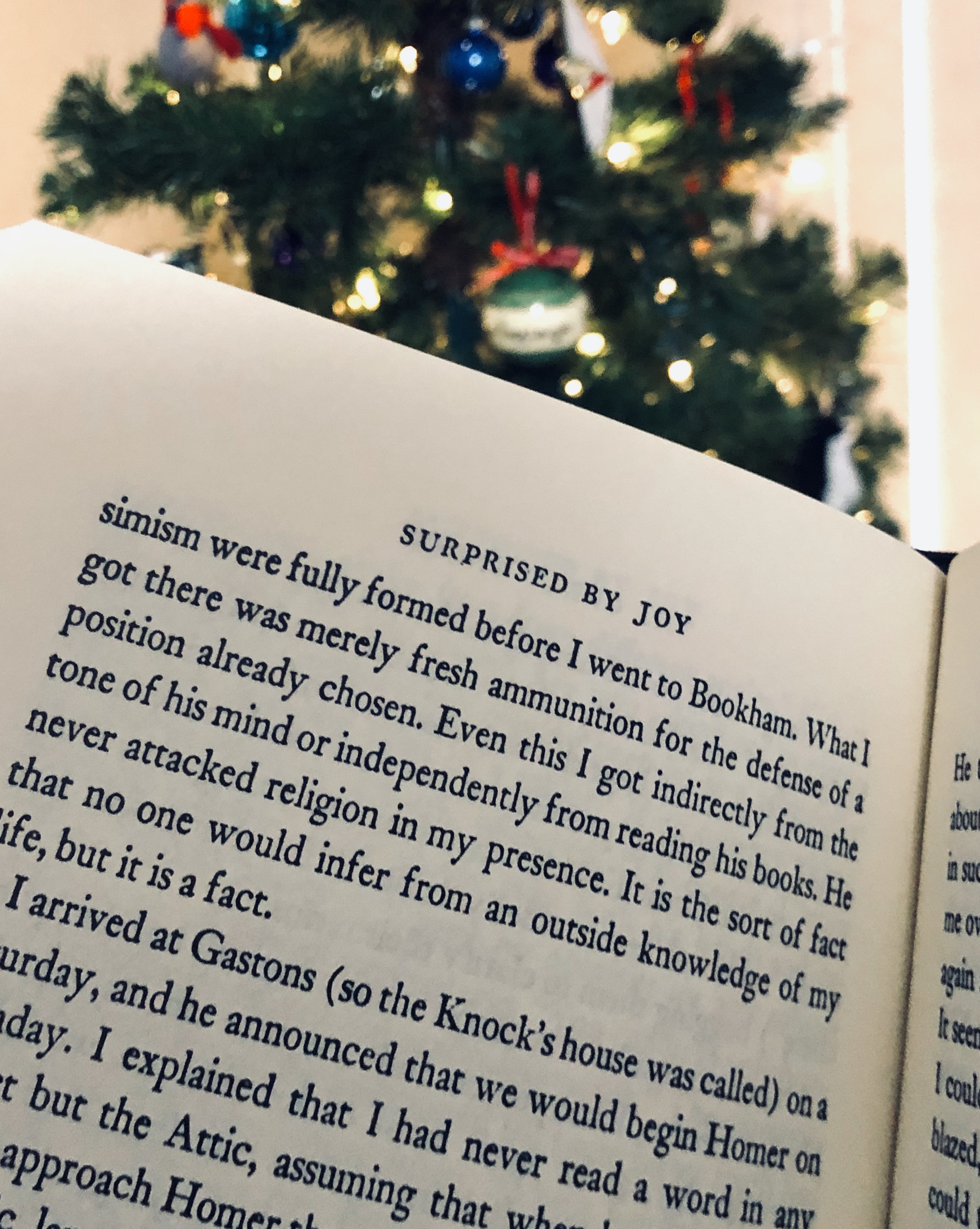
  5. Pursue joy. Joy is my word of the year, and as you may have been noticing in the 31 days series (which we’re just shamelessly going to continue until it’s done, ignoring the fact that the 31 original days for which it was intended have passed), I have a lot to say about it already. You can expect a few updates a month, and I’m going to be reading at least one book a month with joy in the title. The first one I started with the blog series was Surprised by Joy (which I expect to finish within the week). January has three selections by the same author – Jennifer McCartney’s The Joy of Being Online All the F*cking Time, The Joy of Leaving Your Sh*t All Over the Place, and The Joy of Doing Just Enough. In a month where everything else is certain to be pretty intense, I expect these books will bring a little levity.

Do you make resolutions? If not, do you have goals you’re working toward? I’d love to hear about them!

Read Full Post »

Day 12 – Anticipate

“All Joy reminds. It is never a possession, always a desire for something longer ago or further away or still ‘about to be’.”
― C.S. Lewis, Surprised by Joy: The Shape of My Early Life

I recently wrote a blog piece for my copywriting/SEO job on finding joy, and a lot of the research I found when doing so indicates that having something to look forward to is a big part of joy. That makes sense. I’m all for being in the moment, but if you are already feeling low on joy or happiness, focusing on the here and now may not be super helpful.

I’m also re-reading Surprised by Joy (this month’s “book with ‘joy’ in the title” selection), and C.S. Lewis wrote about his experiences of joy as exhilarating, fleeting moments where he felt an intense longing for something. For example, just the idea of autumn or another favorite time of the year can spur you to hope. Even if the time is far away, the anticipation can jolt you into a temporary state of euphoria.

I don’t typically think of unfulfilled desires or unrealized experiences as things that produce pleasant feelings. Most of my loneliness, after all, stems from the absence of experiences that I really want to be a part of my everyday life. At the same time, however, with the help of whatever scraps of hope I am able to scrounge together in the moment, joy can still show up. When I think of the characteristics I particularly love in a partner – and especially when I meet someone new who embodies a lot of those characteristics – there is that jolt. The familiar memory of loving someone combined with the anticipation of the possibility of feeling that way again? That feeling is pure magic.

This is the sneaky good thing about joy that may just be my favorite part. It doesn’t just show up in the middle of a particular difficulty. It shows up, in part, specifically because of it. Joy will tailor itself to you.

I think that whenever I’m feeling particularly joyless, I’m going to focus on something I’m looking forward to or indulge my daydreams about how great it would be to have certain hopes come true. I want to learn to anticipate and thus invite joy to surprise me by sneaking up alongside the sorrows.

I’m writing about chasing joy for the 31 days of December. Click here to see the whole list.

Read Full Post »

Day 11 – Rest

“When we treat workaholics as heroes, we express a belief that labor rather than contemplation is the wellspring of great ideas and that the success of individuals and companies is a measure of their long hours.”
― Alex Soojung-Kim Pang, Rest: Why You Get More Done When You Work Less

This year has been a test of what some call work-life balance. I have spent most of 2020 working from home, and I have become intimately acquainted with the home office. A room that used to be for books and writing (when I could find the desk) but mostly storage has become a workable space that I love. And it’s a good thing I do, because not only do I regularly spend my 40-hour full-time work week and my 15(ish)-hour part-time work week here, I also use the space for zoom meetings with church and friends and for binge-watching Schitt’s Creek and The Good Place.

When work and home are the same place, you have to draw clear boundaries around rest. I recently read Alex Soojung-Kim Pang’s book on the subject and found that the author’s findings match my experience pretty well. I can do about two or three days of doing almost nothing but then I start to get restless. During longer breaks (such as the one I’m on now), the things I find rejuvenating are more active:

  • Exercise
  • Free-form writing
  • Piano practice
  • Dance
  • Reading
  • Napping (okay, that’s not active, but it’s soooo good)
  • Deep cleaning

My days are more free-form. They start later and end later. But there is more to them than just lying around doing nothing, and that is what gives me true rest. Physical activity demands that I just do one thing at a time, and it makes me more alert. It also helps me sleep better than I do during the busy weeks when I claim to not have time to work out.

Working from home has made stronger boundaries necessary but it has also given me the luxury of less transition time between working hours and downtime, erasing the illusion that I don’t have time to do the things that I want to do. Simply not commuting hasn’t added many hours to my workday, but being at home allows me to take more frequent breaks during which I can sneak in a quick 75-second plank or a couple minutes of kickboxing throughout the day. Maintaining active rest breaks instead of just vegging out for five minutes a few times a day has made me so much more productive. I still stick to the 40 hours I’m paid to work at my full-time job, but I have cut my hours down from 20-25 a week to about 15 at my part-time job, and I wrote just as many words this year as I did last year.

Just reading that gives me a little jolt of joy.

I’m writing about chasing joy for the 31 days of December. Click here to see the whole list.

Read Full Post »

« Newer Posts - Older Posts »